
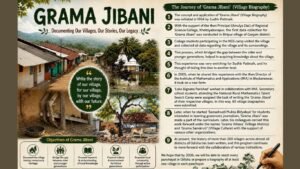
Every village has a past of its own, which is not merely confined to the pages of history, but remains alive in the memories of the village elders, traditions, nature, and lifestyle. This documentation is a beautiful attempt to explore the history, social transformation, and way of life of ‘Sujeli’, a small village surrounded by dense forests and hills under G. Udayagiri Block in Kandhamal district.
This article has been prepared based on information collected from experienced senior citizens of the village: Patri Sahu (85), Hiramani Sahu (90), and Raja Sahu (82). It describes how this village, which began in 1889 with just 3 houses and 13 inhabitants, transformed over time into a harmonious settlement of 54 families across various communities.
This collection presents a clear picture of the naming of the village, early struggles with forests and wild animals, the transition from traditional organic farming to modern agricultural methods, food habits, culture, festivals, and current rural challenges (such as migrant labor, unemployment, and superstition).
All these details were gathered and presented beautifully by Simran Sahu, a daughter of Sujeli village and a +2 1st Year (Arts) student at Indira Priyadarshini Women’s Higher Secondary School, G. Udayagiri. A student’s sincere effort and historical inquiry to preserve her village’s culture and heritage are highly commendable.
Village Identity and Geographical Location
The name of our village is Sujeli. It is a small village under G. Udayagiri block. Bajigia village lies to the north, Kurmigia village to the south, and Suradai village to the west. In short, three villages surround our village, while the eastern side is bordered by a dense forest.
The first residents of our village were natives of Kulada village near Bhanjanagar. They belonged to the Sundhi community. They initially came here looking for work. After working here for a few days, they realized that the location offered good opportunities for settling down. They returned to Kulada, brought their families, and became the first permanent settlers. Since they belonged to the Sundhi lineage, they named the village ‘Sujeli’ after their caste/community lineage. Others say that because the village experiences extreme cold—causing cracked feet and severe chill, known as ‘Suga’ in the Kui language—the village came to be known as Sujeli.
Our village was established in 1889. The first inhabitants were Rupa Sahu, Anta Sahu, and Nabi Malik. Later on, Sandha Sahu, Kaibala Sahu, Paraju Sahu, Captain Malik, Bradhe Pradhan, Karna Pradhan, and their families settled here. When the village was established, there were only 3 houses and a population of 13. Currently, there are 54 houses with a population of over 250. People from Hindu, Tribal, and Christian communities live together in our village.
Water Resources and Connectivity
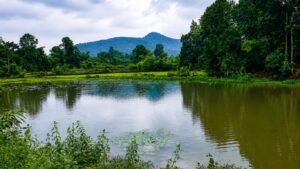
Our village had a river, a pond, and dug-well pits (Chua), but no natural streams (Jharana). The villagers used Chua water for drinking. River and pond water were used for bathing cattle, personal bathing, washing clothes, and farming. Later, concrete wells were constructed, and well water was used for drinking.
When our village was established, the surroundings were completely covered by dense forests. As people gradually settled, the forest area slightly decreased. Because of the surrounding thick jungle, wild animals lived close by, posing constant threats to life. Today, the environment is much better. With the increase in population, the forest cover near the settlement decreased, driving wild animals further away.
Previously, villagers relied solely on Chua and well water for drinking, but now, under the government’s ‘Basudha’ scheme, clean drinking piped water reaches every household.
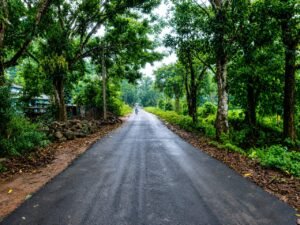
The village road, which was once made of dirt and mud, has now been converted into a paved asphalt road.
Evolution of Agriculture and Dietary Habits
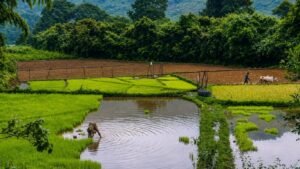
In the past, farmers used wooden plows and bullocks for farming, relying entirely on organic manure. Today, farmers use modern machinery, allowing farming activities to be completed in less time. Chemical fertilizers are also widely used now.
Earlier, crops like paddy, finger millet (Mandia), pearl millet (Bajra), Janta, Koeri, pigeon pea (Kandula), turmeric, potatoes, pumpkin, green gram (Muga), and black gram (Biri) were cultivated. Alongside these traditional crops, new vegetables are grown today, such as peas, chilies, onions, cabbage, cauliflower, carrots, brinjal, pointed gourd, radish, lychee, bananas, mustard, and various leafy greens, fruits, and flowers.
Difference between past and present farming methods: Yes, there is a distinct difference. Previously, villagers used traditional tools like plows and yokes, which required more time and labor while producing lower yields. Now, farming utilizes modern machinery like tractors, power tillers, and grass cutters along with chemical fertilizers, resulting in higher yields with less physical labor and time. However, due to excessive chemical fertilizer usage, modern produce does not last or store as long as organic produce from the past.
Our traditional diet consisted of finger millet porridge (Mandia Jau), millet cakes (Mandia Pitha), rice, bamboo shoots (Baunsa Kadi), pigeon peas, potatoes, leafy greens, and wild roots/fruits. Today, along with traditional foods, we consume modern varieties of vegetables, oil extracted from sunflower and mustard seeds, pumpkin flower fritters, and spicy/oily restaurant food. For rice, we consume raw rice, parboiled rice, and government-supplied control rice under the ‘Annapurna’ scheme.
Elders note that eating food grown purely with organic manure kept their bodies healthy, strong, and disease-free. In contrast, modern food—often stale, oily, and heavily spiced—causes various illnesses. Rather than eating healthy foods like rice, flatbread, and millet, the younger generation prefers eating out at hotels.
Religious Beliefs, Festivals, and Culture
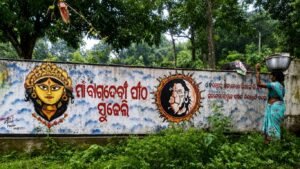
Our village does not have formal temples or mosques, but it has a Baptist Church (established in 1988) and a Matha (monastery, established before 1900). These places play a crucial role in our lives, teaching us about our customs, traditions, morality, and social values.
Major festivals celebrated in the village include Raja Sankranti, Ganesh Puja, Saraswati Puja, Anla Navami, Rama Navami, Diwali, Kartika Purnima, Ratha Yatra, Makara Sankranti, Pana Sankranti, Maha Shivaratri, Holi, Dola Purnima, Nuakhai, Rakhi Purnima, Chhada Khai, Janmashtami, Vishwakarma Puja, Christmas, and Good Friday. In the past, festivals were celebrated with traditional folk instruments and singing; today, Bluetooth speakers are commonly used.
Earlier, nature worship, land/earth worship (Bhumi Puja), and ritual animal sacrifices were more prominent. Today, sacrificial rituals are restricted to specific places—for instance, goat sacrifices are still offered to Goddess Mangala in Sujeli.
Traditional festive foods included Manda Pitha, Poda Pitha, Khiri, and Chakuli during Raja; sweet drink (Pana) during Pana Sankranti; rice, dal, and chicken during Diwali; and raw rice with dal, fried side dishes, and papad during Manabasa Gurubar. Today, these are supplemented by items like Arisa Pitha, Kakara Pitha, paneer, chicken, mutton, mixed vegetable curry (Ghanta), and various sweets (Laddoo, Rasgulla, Gulab Jamun, Khasa, Seu, Bundi, Barfi, etc.).
Education, Health, and Local Markets
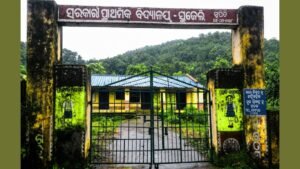
Our village has two educational institutions: an Anganwadi Center (established in 1996) and a Primary School (established on June 1, 1958). The Anganwadi initially had 14 children and now has 7. The Primary School had 17 students initially and currently has 22.
Children who drop out of school either work in agriculture or migrate to other cities/states to earn a livelihood. More than half of the village population migrates out for work—some due to a lack of local employment and others dissatisfied with low local wages. They migrate to places like Visakhapatnam, Andhra Pradesh, Karnataka, Tamil Nadu, Thrissur, Kerala, Bengaluru, and Mumbai.
There is a weekly market (Haat) located 5 km from the village. Residents buy vegetables, fruits, and essentials at affordable prices and also take their farm produce there to sell.
Common health issues in the past included dengue, malaria, cholera, diarrhea, cough, headaches, cold/fever, and abdominal pain. Today, more severe illnesses like cancer, tuberculosis (TB), typhoid, rheumatic fever, and pneumonia are reported.
In the past, people had little awareness of disease causes, but awareness is gradually growing. However, illiterate villagers still lack adequate health knowledge. The nearest hospital is 5 km away. When ill, villagers try home remedies first; if ineffective, they visit the hospital for treatment and medications. Most medicines are provided free, though some must be purchased.
Challenges and My Resolution
Issues like unemployment, substance abuse, and superstition in our village cause deep concern. Youth in our village are harming their health by skipping education and consuming cigarettes, Gudakhu/Gutkha and alcohol.
Superstition still persists. However, it would be incorrect to call it entirely fake, as some people recover through traditional faith healing (Jhada-phunka) when hospital medicines fail them, though fraud practitioners also exploit beliefs and spread superstition. I will try my best to educate everyone, raise awareness, and work toward eradicating unemployment, addiction, and blind beliefs for the betterment of our village.
My Commitment
As an aware student of this village, I will constantly focus on educating the villagers, eliminating unemployment, preventing substance abuse, eradicating superstition, and striving for the overall development and progress of my village.
Simran Sahu
+2 1st Year Arts
Indira Priyadarshini Women’s Higher Secondary School, G. Udayagiri
Odia: https://thesamadrusti.com/5320/
Contact: 9853456083 (Sibasish Ray, Centre for Village History and Heritage Studies)
Comments
0 comments