
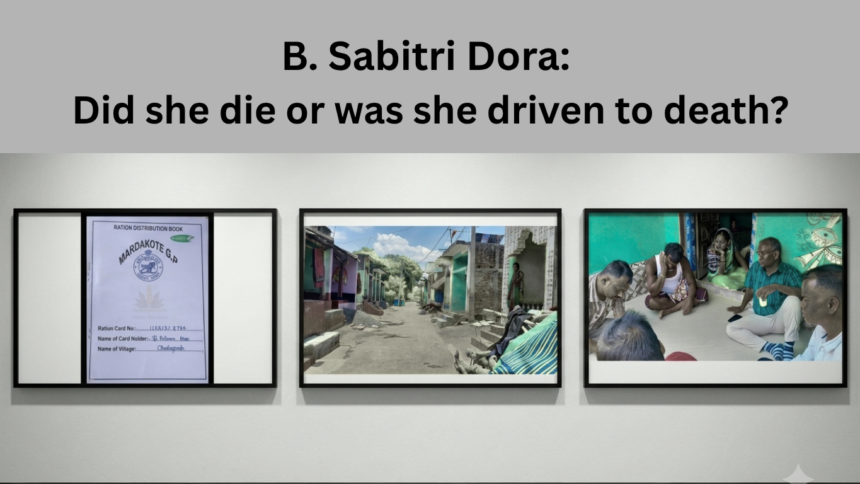
On June 16, 2026 B. Sabitri Dora, an elderly widow of Chadeiyapada village of Mardakot Gram Panchayat in Beguniapada block of Ganjam district, consumed poison and died on her way to hospital. We ordinary, casual and non-serious readers normally skip such news when we read the newspaper. But there are some people who have been continuously monitoring the social security pension disbursement schemes and have been struggling to draw our attention to the issue of non-payment, delay and disruptions in the disbursement of pensions. A pension amount of Rs 1000 is nothing for the junk food eating aggressively urbanized population, but for a social security pensioner it means a world. These people could sense that there was something wrong in the reporting of Sabatribai Dora’s suicidal death. They immediately sat and thought together to go for a proper fact finding to her village. They were from the ‘Right to Food Campaign’, ‘Civil Society Forum for Human Rights’ and ‘Campaign for Survival and Dignity’. The following report was a product of the fact finding team’s visit to the area on 24 June 2026. We produce here the entire report for the benefit of our readers. One may critique the report and may also suggest what more could be done to know the situation in all vulnerable places and populations of the State of Odisha. – Online Editor, Samadrusti
Report of the Fact Finding Team
Executive Summary
This report documents the circumstances leading to the death of Smt. B. Sabitri Dora, an elderly widow of Chadeiyapada village in Beguniapada block of Ganjam district, who consumed poison on 16 June 2026 and died on her way to hospital. According to her family, she had not received her monthly widow pension of Rs. 1,000 for roughly three months, and the resulting financial distress and helplessness culminated in this tragedy.
The fact-finding exercise indicates that her death was not an isolated act, but the outcome of a state-wide failure: the disruption of social security pension disbursement across Odisha for about three consecutive months during April–June 2026, attributed by the State Government to technical problems in the digital payment portal. In Ganjam district alone, over 1.49 lakh pension beneficiaries reportedly went unpaid during this period; state-wide, nearly 18 lakh pension holders were affected.
Two features of the case stand out. First, a person entirely dependent on a modest monthly pension for food and medicine was left without it for three months, with no interim or manual mechanism to protect her. Second, the very digitization drive meant to make delivery efficient became the single point of failure that cut off the most vulnerable. This report argues that cash and doorstep disbursal options must be retained as a safeguard, and sets out detailed recommendations in Section 14.
1. Background
In mid-June 2026, several news outlets reported that an elderly widow in Ganjam district had died after consuming poison, allegedly because she had not received her social security pension for about three months. The deceased was identified as Smt. B. Sabitri Dora of Chadhiapada village under Beguniapada block. The incident occurred on 16 June 2026 and came to public attention two days later, when her family spoke to the media. It quickly became part of a wider public controversy over the prolonged non-disbursal of pensions across Odisha during April–June 2026.
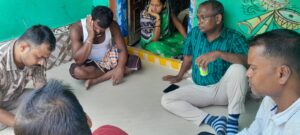
Against this backdrop, a joint fact-finding team comprising members of the Right to Food Campaign, Campaign for Survival and Dignity and the Civil Society Forum for Human Rights visited the village to verify the facts, understand the sequence of events leading to her death, and situate the incident within the larger institutional context of the pension disbursement crisis in the state.
2. Members of the Fact-Finding Team
The joint fact-finding team comprised the following members:
- Rakhi Ghosh, Independent Journalist
- Ranjit Sutar, Civil Society Forum for Human Rights
- Sameet Panda, Right to Food Campaign
- Sankar Pani, Advocate
- Sricharan Behera, Campaign for Survival and Dignity, Odisha
3. Objective and Methodology
The primary objective of the fact-finding exercise was to verify the veracity of the information being reported in the media about the death of Smt. B. Sabitri Dora, and to understand the circumstances that compelled her to take such a step. A secondary objective was to examine the social, economic and institutional background of the incident, and the wider pension-disbursement failure of which it formed a part.
The methodology was straightforward. The team visited Chadhiapada village on 24 June 2026 and held conversations with:
- Sabitri Dora’s daughters and other immediate family members;
- Neighbours and other community members;
- The ward member and Gram Panchayat functionaries;
- The Block Development Officer (BDO).
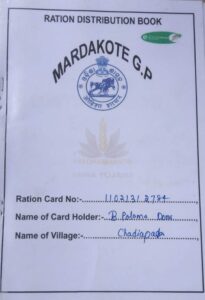
The team triangulated oral testimony with documentary evidence wherever available – including the pension passbook/records, ration card and bank passbook — and with government data and media reports on the state-wide pension situation.
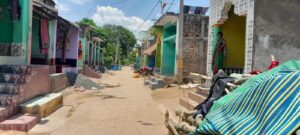
4. Date and Place of Visit
Date of visit: 24 June 2026
Places visited: Chadhiapada village, Mardakot Gram Panchayat, Beguniapada block; and the Beguniapada block office, in Ganjam district of Odisha.
5. The Incident of 16 June 2026
On the morning of 16 June 2026, at around 8 a.m., Sabitri Dora went to the house of her second daughter, Smt. G. Chanda Dora, who is married and lives in the same village. She wanted her daughter to accompany her to the block office to inquire, once again, about her pending pension. According to Chanda, her mother looked pale and visibly disturbed. Chanda asked her to wait a little while. Without waiting, and without heeding those around her, Sabitri left the place. She lost any hope and assurance of getting the pension money the only source of her survival.
A few hours later, villagers informed Chanda that her mother had been found lying unconscious near the village pond. Chanda rushed to the spot and took her to the Kodala Community Health Centre, from where she was referred to MKCG Medical College and Hospital at Brahmapur. She died on the way to the hospital. The autopsy was subsequently conducted at MKCG Medical College and Hospital.
In her family’s account, she consumed poison out of the distress and helplessness caused by not receiving her pension for about three months.
6. Background of Smt. B. Sabitri Dora and her Family
- Sabitri Dora was an elderly widow, in her mid-sixties. She hailed from Chadhiapada village under Mardakot Gram Panchayat of Beguniapada block in Ganjam district. Her husband, late Shri B. Guna Dora, died about seventeen years ago. Since his death she has been receiving widow pension.
Sabitri had three daughters, all of whom are now married. After her husband’s death she supported the family by working as a daily-wage worker; but for roughly the last ten years, ill health had left her unable to do such work. She lived largely on her own, and depended on her monthly pension to meet her medicines and other basic needs. Family members told the media that she also received 5 kg of rice per month under the food security (NFSA) scheme.
7. Social Security Entitlements
Documentary and testimonial evidence indicates that Sabitri Dora was a rights holder of the following entitlements:
- A monthly social security pension of Rs. 1,000. Her family described this as a widow pension, received for about 17 years since her husband’s death. The Beguniapada Block Development Officer, however, stated to the media that she was a beneficiary under the Indira Gandhi National Old Age Pension Scheme (a component of the centrally-supported National Social Assistance Programme, NSAP), and that she had last received her pension in March 2026.
- A food grain entitlement under the National Food Security Act — reported by the family as 5 kg of rice per month.
She had no independent, regular source of income, and was therefore almost entirely dependent on the monthly pension for survival, food and medicine.
8. Sequence of Events Leading to the Incident
8.1 The stoppage of pension (April–June 2026)
Sabitri Dora’s pension was not credited for roughly three months in the period April to June 2026. The block administration’s own account places her last receipt in March 2026. This was not peculiar to her: across Ganjam district, over 1.49 lakh pension beneficiaries reportedly did not receive their monthly pensions for about three months during this period, and the disruption extended across Odisha (see Section 9).
8.2 Repeated visits and mounting distress
Being wholly dependent on the pension for her medicines and daily needs, Sabitri was acutely affected by its stoppage. According to her family, she repeatedly visited the Gram Panchayat office and the block office to inquire about her pending pension, and also repeatedly checked at the bank to see whether the amount had been credited. Each of these visits was fruitless. The uncertainty and the deepening financial crisis caused her severe stress and a sense of helplessness in the weeks before her death.
8.3 The final day — 16 June 2026
On 16 June 2026, Sabitri once again set out to inquire about her pension, seeking her daughter’s company to go to the block office. Disturbed and unwell in appearance, she left before her daughter was ready, and shortly afterwards consumed poison near the village pond. She died on the way to hospital. In her family’s account, the proximate trigger was the despair caused by three months without the pension on which her survival depended.
9. The Broader Context: Odisha’s Social Security Pension System and the 2026 Disbursal Crisis
In Odisha nearly 55 lakh elderly persons, widows, persons with disabilities and few other categories of people are covered under social security pension schemes. The state’s own Madhu Babu Pension Yojana (MBPY), which has around 36 lakh beneficiaries, alongside roughly 20 lakhs under the centrally-supported National Social Assistance Programme (NSAP). Pension holders between 60 and 79 years of age typically receive Rs. 1,000 per month, while those aged 80 and above (and persons with 80% or more disability) receive Rs. 3,500. In its 2025-26 budget, the state government set aside about Rs. 7,600 crores for these pension schemes and announced an enhancement of pension amounts. The 2026-27 budget carried a large social-security allocation and announced “saturation,” bringing an additional six lakh previously-excluded persons under the MBPY. (Sources: The Indian Express, June 2026; Odisha Budget documents, 2025-26 and 2026-27; SSEPD department data.)
Between roughly April and June 2026, this disbursement was disrupted across Odisha for about three consecutive months. The State Government attributed the failure to technical glitches and software problems in the digital payment portal used to process Direct Benefit Transfer (DBT) payments — specifically the integration of the SNA-SPARSH (Single Nodal Agency) platform through which NSAP pensions are routed. The Social Security and Empowerment of Persons with Disabilities (SSEPD) Minister and the Chief Secretary publicly maintained that the disruption was temporary and technical, that no eligible beneficiary would be deprived, and that all arrears would be cleared. In mid-June, the Leader of the Opposition and former Chief Minister wrote to the Chief Minister stating that nearly 18 lakh beneficiaries had gone unpaid for three months, describing the situation as a grave failure of governance and citing Sabitri Dora’s death; opposition leaders noted that under the previous administration, pensions had been disbursed by the 15th of each month, often through doorstep delivery on a designated “Jan Seva Diwas.” By the end of June, the government reported that it had credited April and May dues to over 17.6 lakh pension holders (about 91.5% of the total) and had begun processing June payments. (Sources: The Indian Express; OdishaTV; OdishaBytes; Pragativadi; Dinalipi; statements reported in national and regional media, June 2026.)
10. Digitisation and the Case for Cash Pension in the Hands of Pensioners
Odisha’s pension delivery has been progressively digitised — through Aadhaar-seeded bank accounts, e-KYC, and Aadhaar-based DBT on the SNA-SPARSH platform. The state has directed District Collectors to complete Aadhaar–bank linkage for the roughly 3.35 lakh NSAP beneficiaries still on the older account-based system, warning that from 2026-27, NSAP pensions will be disbursed exclusively through the Aadhaar-based payment system. Digitisation is defended on grounds of transparency, de-duplication and the elimination of leakages — real and legitimate objectives.
However, the 2026 crisis exposes the danger of a fully digitised, single-channel model with no analogue fallback. When one portal fails at the state or national level, the failure cascades simultaneously to millions of the poorest people, who have no recourse. For a pension recipient like Sabitri Dora — elderly, ailing, with no regular income and no buffer — a three-month interruption is not an administrative inconvenience but a threat to survival. Aadhaar-seeding and e-KYC requirements can also exclude the very people the schemes exist to protect: those who cannot easily authenticate biometrically, whose Aadhaar is unlinked, or who lack the mobility and documentation to correct errors.
The case for retaining cash disbursal in the hands of pensioners is therefore not nostalgia, but risk management and dignity. Cash — or doorstep delivery, as under the earlier “Jan Seva Diwas” model — provides an immediate, portal-independent safety net; it does not depend on bank-branch access, network connectivity or biometric success; and it reaches the bedridden, the very old and the isolated who cannot travel to a bank. A resilient system should treat digital DBT as one channel among several, with a guaranteed manual/cash fallback that is triggered automatically whenever the digital channel fails for more than a defined number of days. The central lesson of April–June 2026 is that removing that fallback converts an ordinary technical fault into a life-and-death crisis for the most vulnerable. To address the technical fault for such a prolong periods that entirely frozen such an extremely important and critical service delivery need for the most vulnerable population group appears to be patently causal and insensible attitude of the state bureaucracy, in the era of digitisation and artificial Intelligence.
11. Aftermath of the Incident
Once the incident drew media attention, the block administration and the State Government responded:
- The Beguniapada BDO described the death as “unfortunate,” stated that the cause of death was yet to be ascertained pending the post-mortem report, and directed the Panchayat Executive Officer to conduct a preliminary inquiry.
- The incident became a flashpoint in a state-wide political controversy over the pension delay, with the opposition citing Sabitri Dora’s death in its criticism of the government.
- The State Government reiterated that the disruption was due to technical/software issues, that arrears would be cleared, and subsequently reported crediting April and May pension dues to over 17.6 lakh beneficiaries state-wide.
12. Key Observations and Questions
12.1 The pension delivery system
- How was a wholly dependent, elderly widow allowed to go without her pension for three months, with no interim mechanism to identify and protect such acutely vulnerable beneficiaries?
- If the disruption was purely a technical/portal problem, why was no manual or cash disbursal activated as a stopgap, as had been the practice earlier?
12.2 Local administration and grievance redress
- Sabitri repeatedly approached the Gram Panchayat office, the block office and the bank. Why did none of these repeated grievances trigger any response, escalation or interim assistance?
- Was there any functioning grievance-redress mechanism at the block/panchayat level for pension non-payment, and if so, why did it not reach her?
12.3 The digitisation question
- On what basis is the state moving to an exclusively Aadhaar-based, single-portal disbursal model, given that this same architecture produced a simultaneous three-month failure for millions?
- What fallback exists for beneficiaries whose Aadhaar is unlinked, whose biometrics fail, or who cannot reach a bank?
13. Conclusion
The death of B. Sabitri Dora is not merely an individual tragedy but a signal of systemic failure. The system has created a situation of anomie for its most vulnerable senior citizens due to sheer insensitivity and non-accountability by the State Administration. An elderly widow, without income or family support close at hand, dependent on Rs. 1,000 a month for food and medicine, was left without that pension for three months because of a failure in a digital payment system over which she had no control and no recourse. She did what she could — repeatedly visiting the Panchayat, the block office and the bank — and was met each time with silence.
That the state was able to disburse arrears to 17.6 lakh people within weeks of the crisis becoming a public and political issue shows that the money existed and the payments were possible; what was missing was urgency, a human safety net, and any mechanism to catch those, like Sabitri Dora, for whom a three-month delay is not survivable. The Right to Food Campaign, Campaign for Survival and Dignity and the Civil Society Forum for Human Rights place this report on record in the hope that it will inform urgent corrective action, and help prevent the next such death.
14. Recommendations
Based on its findings, the fact-finding team places the following recommendations on record, and requests urgent and time-bound action on each.
14.1 Immediate relief and accountability in this case
- Release forthwith all pending pension arrears due to Sabitri Dora to her legal heirs, along with any food grains entitlement due.
- Extend appropriate ex-gratia relief/compensation to her family, and treat the family as a priority for continuing welfare support.
- Conduct an independent inquiry — not confined to an internal preliminary inquiry — into her death, expressly examining the three-month pension stoppage as a contributory factor, and place the findings in the public domain.
14.2 On restoring and safeguarding pension disbursal
- Ensure that all arrears for April–June 2026 are credited to every affected pension holders across Odisha, with a public, district-wise reconciliation confirming that no one has been left out.
- Institute a binding service standard that pensions are credited by a fixed date each month (for example, the 15th), with automatic escalation and public reporting whenever disbursal is delayed beyond a defined threshold.
- Establish a real-time, publicly-visible dashboard of pension disbursal status at district and block level, so that stoppages are detected and acted upon within days, not months.
14.3 On digitization and the retention of cash/doorstep disbursal
- Do not move to an exclusively Aadhaar-based, single-portal disbursal model. Reinstate, in rule and in practice, a manual/cash and doorstep-delivery option (on the lines of the earlier “Jan Seva Diwas”) for all the pension beneficiaries in the state.
- Mandate an automatic cash/manual fallback: whenever the digital DBT channel fails for more than a defined number of days, the block administration must disburse pensions manually/in cash until the channel is restored.
- Prohibit the denial or stoppage of pension on grounds of pending Aadhaar-seeding, e-KYC or biometric-authentication failure.
- Prioritise doorstep delivery for bedridden, very old and isolated pension holders.
14.4 On identifying and protecting acutely vulnerable beneficiaries
- Maintain a flagged list of “solely dependent” beneficiaries (elderly single women, widows, persons with disabilities, and destitute persons with no other income) for whom any interruption is life-threatening, and protect them first during any disruption.
- Require ASHA/Anganwadi workers, ward members and panchayat functionaries to proactively check on such beneficiaries during any disbursal delay.
14.5 On grievance redress
- Establish a simple, accessible grievance-redress mechanism for pension non-payment at the panchayat and block level, with a time-bound response and a helpline, and ensure it is publicised.
- Ensure that every visit or complaint by a beneficiary about non-payment is logged and acted upon, with a designated official accountable for resolution.
14.6 On monitoring and review
- The Department of Social Security and Empowerment of Persons with Disabilities should conduct and publish a review of the April–June 2026 disbursal failure — its cause, the number of persons affected, and the corrective measures taken — and place it before the State Legislature.
- Facilitate independent civil-society monitoring of pension disbursal through transparent, disaggregated public data.
Note on Sources
Case facts (Sections 5, 6, 8) are drawn from the fact-finding team’s interactions with the family and community and from the family’s account. Contextual and quantitative facts on the state-wide pension situation, the disbursal crisis, and budget allocations (Sections 9–11) are drawn from government budget documents (Odisha Budget 2025-26 and 2026-27), statements of the SSEPD Minister and Chief Secretary, and reporting in June 2026 by The Indian Express, OdishaTV, OdishaBytes, Pragativadi, Dinalipi and other outlets. Figures reported by different sources occasionally vary; where they do, this has been indicated. Items in square brackets are placeholders to be completed by the team from its
Comments
0 comments