
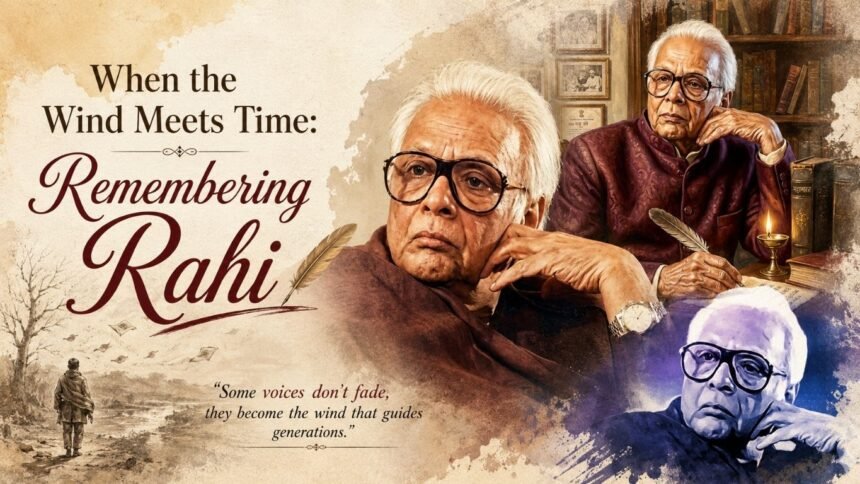
The term ‘saba’ (wind) can be used to express that Rahi Saheb has indeed left a profound impact on the sands of time, not only within Urdu literature but also in Hindi writings, showcasing equal skill. His timeless opening line from the epic TV series ‘Mahabharat’ will be remembered: “Main Samay hoon, aur aaj Mahabharat ki amar katha sunaney ja raha hoon.” (I am Time, and today I am going to narrate the immortal story of the Mahabharata.) This unforgettable mark was established even before the series premiered in 1988, reaching its peak with Harish Bhimani’s resonant voice every Sunday morning on Indian television for the subsequent two years. Rahi Saheb has achieved immortality, as noted by Bibhuti Pati.
Mahabharat!
Rahi Masoom Reza was born into a wealthy family of Shia landlords in Gangauli village, located in Ghazipur, eastern Uttar Pradesh. His frequent illnesses deprived him of valuable academic years; however, after completing his education at Aligarh (with unverified reports suggesting he also attended Allahabad), he enrolled at Aligarh Muslim University. There, he began teaching while simultaneously writing Urdu short stories and poetry that garnered significant acclaim.
Writers who possess good looks (and he certainly did) often attract a considerable following, particularly among female readers, especially if they bear some form of emotional or physical scar. According to rumors circulating in literary circles, Rahi Saheb’s undeniably sophisticated demeanor, his flawless language, his sherwani, and Aligarhi pyjamas, coupled with a slight limp (a consequence of childhood polio), contributed to his status as a literary icon. His language and presence exuded a certain charm, reminiscent of a man who could scarcely suppress a profound and rare joy while maintaining his dignity as an academic.
Despite being celebrated, scrutinized, and subjected to various forms of criticism regarding caste, language, and nationality by audiences from India and Pakistan, he remained composed until the end regarding the ‘attention’ his Urdu and Hindi novels, as well as the grand screenplay of Ved Vyas’ Sanskrit epic ‘Mahabharat’, received.
In 1966, he wed Nayyar Jahan, a high-born divorced woman linked to the Rampur aristocracy. This marriage, along with his opinions on adopting Devanagari script for Urdu, led to significant conflicts, culminating in what could be described as a lover’s quarrel with the Urdu community at the university and the Urdu publishing industry.
Afterward, he resided in Mumbai, where he excelled at multitasking, contributing to both Hindi print magazines and the film industry. Few are aware that as an Urdu author, he once ventured into writing crime fiction under the pseudonym Shahid Akhtar, achieving popularity that rivaled that of the renowned Urdu crime writer, Ibn-e-Safi from Allahabad.
His Hindi literary works quickly propelled him to prominence, with notable novels such as ‘Aadha Gaon’ and ‘Topi Shukla’, along with his contributions as a scriptwriter and lyricist for numerous films, culminating in his script for the monumental epic of the great fratricidal conflict, ‘Mahabharat’.
One character in ‘Aadha Gaon’ articulates: “People advised me, brother, go anywhere, converse in English, Urdu, or Hindi, but at home, do not tarnish the language our ancestors have spoken…”
Rahi Saheb consistently honored his heritage throughout his literary journey. He once remarked that he was a son of three mothers: his biological mother, Nafisa Begum, Aligarh Muslim University, and the Ganges. A prolific multi-tasker, he juggled two, three, or even four scripts simultaneously, alongside poems, novels, and various articles. His decision to write fiction and screenplays in Hindi often drew criticism from his fellow Muslim authors, while simultaneously earning him reluctant admiration from Hindi writers.
He steadfastly believed that the preservation of Urdu in post-1947 India depended on replacing the Arabic script with the Hindi Devanagari. I remember the uproar that ensued when Dharmyug published his opinions. Nevertheless, Rahi Saheb did not lament the backlash resulting from his candid expressions.
Non-Hindi Urdu writers perceived his advocacy for the Devanagari script as a betrayal of Urdu. However, they might as well have accused Shakespeare of having a penchant for nobility in his tragedies. Such profound conviction is not a defect in writers of Rahi Saheb’s caliber; rather, it reflects an awareness of the evolutionary demands of a new world that was emerging around us by the late 1960s.
This was occurring while I was a student, and my mother was penning her bestsellers from the remote town of Allahabad. I often hoped that one day a BR Chopra or Raj Khosla would arrive at our humble abode in their luxurious cars to invite her to write a film script based on any of her popular novels serialized by Dharmyug. That moment never materialized. However, she did have the opportunity to meet Rahi Saheb during a visit to Dharmvir Bharati in Mumbai.
He relocated to Mumbai and informed his mother that, in contrast to Aligarh, the environment appeared to him as unattractive, hostile, and toxic. Therefore, similar to her, he opted to remain safe by continuing to compose his screenplays, novels, and articles from home, unlike the majority of successful authors who were accommodated in five-star hotels by their publishers or film financiers to support their work.
Under the enlightened guidance and enduring relationship with two distinguished Hindi writer-editors (Dr. Dharmvir Bharati, the editor of the Hindi weekly Dharmyug, and Kamaleshwar, the editor of the monthly short story magazine Sarika), Rahi Saheb persisted in publishing remarkable literary works that addressed the significant divide of Partition and the evolving landscape of rural India.
‘Aadha Gaon’, translated into English by Gillian Wright, narrates the story of his village Gangauli, which was devastated by Hindu-Muslim riots. His vibrant student character, Topi Shukla, serves as a lens capturing the emerging political leaders of North India and the rivalries present on university campuses.
Numerous interviews with Rahi Saheb have been discovered in archives and are circulating during his centenary year. However, a literary interview encapsulates both the writing and the writer’s life into a brief overview. It does not reveal the true essence of the writer. A personality tends to be more appealing and ‘interesting’ than a collection of printed works. What distinguishes him as an exceptional writer today is the manner in which his books have matured like fine wine.
His prose is grandiloquent in the resonant phrase “Main Samay hoon” (I am Time) from the ‘Mahabharat’. Yet, in his crime fiction, which is steeped in the tangible world of thugs, criminals, millionaires, and covert surveillance, his tone becomes bitter, scathing, cunning, and painfully humorous.
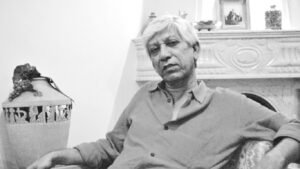
He worked tirelessly till the end, taking no breaks: Iss safar mein neend aisi kho gayi; Hum na soye raat thak kar so gayi… (I lost my sleep during this long journey. Ultimately the night fell asleep, not me). Ai saba tu to udhar se hi guzarti hogi; Us gali mein mere qadmon ke nishan kaise hain… This masoom (innocent) sher belongs to Dr Rahi Masoom Reza, asking the wind what is the state of his footprints in that lane? It is a beautiful and classic example of the type of poetry Rahi Saheb composed. Tender and subtle, romantic yet having social and political overtones. Ye chiragh jaise lamhe; kahin raigan na jayen… Koi khwab dekh dalo; koi inquilab lao…(Lest these lamp-like moments go completely waste, Go weave a dream, or bring about a revolution)
I am an ardent admirer of Rahi, whose poetry, prose, dialogues, film scripts, and satire collectively establish him as a monumental writer. His kindness, humility, humor, intelligence, generosity, and camaraderie rendered him an endearing individual. However, beneath this gentle facade lay a resolute character — a man of unwavering beliefs. In totality, he stands out as a unique Indian author, in my view, second only to Munshi Premchand in terms of his literary skill and body of work.
Rahi Masoom Reza hailed from Gangauli, or Gangoli, a village situated along the banks of the river of the same name in the Ghazipur district of Uttar Pradesh. His family possessed nearly half of this village. His father, Bashir Hussain Abdi, was a prominent lawyer at the Ghazipur district courts. Rahi’s renowned novel, ‘Aadha Gaon’, is inspired by these ancestral details. Despite having a slight disability in one leg (resulting in a mild limp), Rahi was regarded as an attractive man, articulate, and always dressed in a traditional and impeccable manner.
He began his literary journey by writing poetry in Urdu. Originally named Masoom Reza, he chose ‘Rahi’ as his pen name. Rahi was a multifaceted individual, and after achieving success in poetry, he ventured into prose, a decision that proved to be remarkably fruitful.
His literary works, predominantly set in the Gangetic plains of Uttar Pradesh, delve into themes of identity, the Partition, social realities, and human connections. His prominent novels include ‘Aadha Gaon’, ‘Topi Shukla’, ‘Neem Ka Ped’, ‘Oos ki Boond’, and ‘Scene: 75’.
‘Shishe Ke Makan Wale’ is his most celebrated poetry collection. Other notable poetry collections include ‘Mauj-e-Gul Mauj-e-Saba’, ‘Raqs-e-Mai’, ‘Ghareeb Shahr’, ‘Ajnabi Shahr Ajnabi Raste’, and ‘Main Ek Pheriwala’.
In an interview, his wife Nayyar Jahan disclosed that Rahi also authored detective novels. He contributed writings for Nikhat Publications based in Allahabad. There were two series of novels in Urdu and Hindi, titled ‘Jasoosi Duniya’ and ‘Rumani Duniya’. The author Ibn-e-Safi was responsible for writing and publishing these detective series on a monthly basis. Following Safi’s illness and subsequent hospitalization, Rahi assumed control. He wrote under the pen names Shahid Akhtar and Afaq Haider, continuing the publication of ‘Jasoosi Duniya’ for an extended period.
Rahi was known for his sensitivity and simplicity. He had numerous friends who would visit him unexpectedly. His wife affectionately referred to him as Masoom due to his kind and uncomplicated nature. She remembers that Masoom struggled with asking for financial support from producers and directors, occasionally writing a story for merely ‘do beeda paan’.
He rarely negotiated for higher payments. In an interview, his son Nadeem mentioned that he attempted to persuade his father to request more money for his film projects. However, Rahi responded that they lived comfortably, always welcoming guests with meals, sometimes serving up to 15 people, and they had never faced food shortages. He attributed this to God’s blessings, questioning, “Why should I ask for more money?” to Nadeem.
Nayyar shares another intriguing anecdote about their relationship. Rahi took a firm stance in marrying her, despite her being a divorcee, which necessitated his departure from Aligarh, yet he proceeded with the marriage.
Nayyar was an accomplished horse rider. Prior to her marriage to Reza, she actively participated in equestrian sports. After their marriage, Masoom requested Nayyar to cease horse riding. She countered that she would stop if he refrained from attending mushairas. Rahi Saheb, being a reasonable man, assured her that he would never attend a mushaira again, and he kept his word despite significant demand. Nayyar also honored her commitment.
Rahi’s nephew, Prof Nadeem Hasnain, who retired as the head of the anthropology department at the University of Lucknow, fondly recalls, “Mamu always had a perspective on any topic, and once he took a position, it was quite challenging to alter his opinion.”
Everlasting Legacy
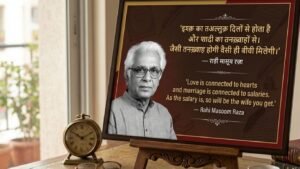
Rahi was a constant dissenter. “During the Emergency period, some authors chose to compose a letter praising Mrs. Indira Gandhi. Rahi disagreed and left the meeting. This exemplifies the courage he possessed,” Hasnain remarks.
Fans of his literary work have frequently speculated whether he excelled more as a poet or as a prose writer. While it is challenging to determine, I will present a few excerpts from his prose and allow the readers to make their own judgment. In ‘Topi Shukla’, he states, “Bhasha ki ladai darasal nafe nuqsan ki ladai hai. Sawal bhasha ka nahin hai. Sawal hai naukri ka (The battle of language is essentially a battle of profit and loss. The issue is not about language. The issue is about employment).”
In another section of the same book, he observes, “Prashn hamara peechha nahin chhodtey. Manushya maut ko jeet sakta hai, parantu prashn ko nahin jeet sakta (Questions never cease to pursue us. A person can conquer death, but he can never conquer questions).”
I present to you this fundamental aspect of Dr. Rahi Masoom Reza’s existential philosophy, accompanied by beautiful advice from the man himself: Umr bhar tune, zamane ka kaha mana hai; Dil ki awaz bhi sun, dekh to kya kahta hai…. (Throughout your life, you have adhered to what the world instructed you to do; also listen to the voice of your heart, and see what it has to say)
This is your everlasting legacy, Rahi Saheb, one that no wind can erase.
His songs in ‘Alaap’ deserve special mention, especially ‘Mata Saraswati Sharda’, the classical song sung by Lata Mangeshkar. The lyrics of this vandana are in Sanskritised Hindi: He Mata Saraswati Sharda; Keeje sudrishti; keeje sudrishti sewak jaan apna; Itna vardaan deeje taan, taal, aur alaap; Buddhi alankaar; Sharda….
This illustrates the breadth of Reza’s knowledge.
It was actor Bharat Bhushan and his brother who extended the invitation to Rahi to come to Bombay. Among his close friends were BR Chopra, Hrishikesh Mukherjee, Raj Khosla, and Gufi Paintal.
Remaining ever humble, Rahi consistently acknowledged his benefactors. He always made it a point to mention his childhood retainer, Kallu Kaka, who shared stories that inspired many of his scripts.
(The views expressed here by the author are his own. If there is any counterview it may please be shared with the Chief Editor at samadrusti@gmail.com)
Comments
0 comments