

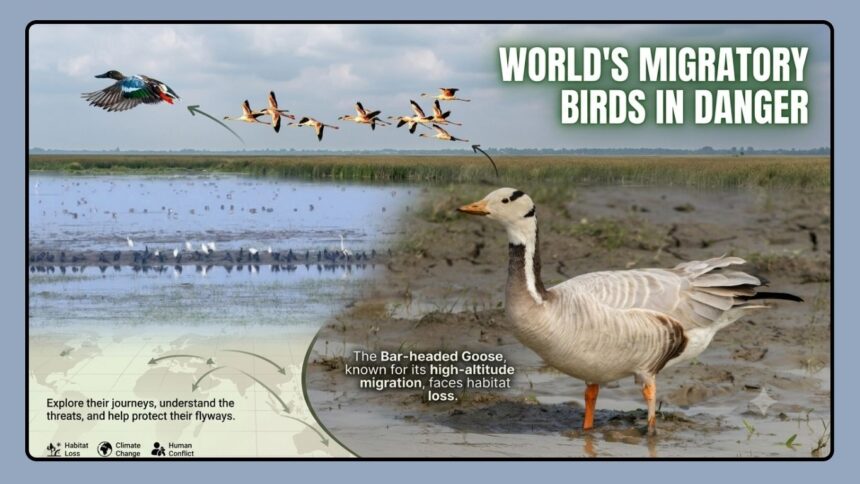
More than half (51%) of the world’s migratory bird species are declining
Threats to migratory birds are increasing, and Odisha is no exception
A major global study has revealed that more than half of the world’s migratory bird species are experiencing population declines. The review, led by researchers from Georgetown University in collaboration with scientists from several international ornithological institutions, including the State of India’s Birds (SoIB) initiative, highlights the urgent need for coordinated global conservation efforts.
Migratory birds travel across continents, oceans, and international borders every year as part of their life cycle. They depend on a network of interconnected breeding grounds, stopover sites, and wintering habitats. However, climate change, rising temperatures, changing seasonal patterns, habitat destruction, and rapid urbanization are exposing these birds to multiple threats throughout their migration. These pressures have reduced their survival rates and made their conservation increasingly difficult.
According to the study, populations of nearly 51% of migratory bird species are declining across the world’s major migratory flyways. Around 300 species are already globally threatened with extinction, while many species that were once common are now declining rapidly, reflecting the seriousness of the global biodiversity crisis.
The report also notes that long-distance migratory birds travelling from the Arctic to India are declining faster than resident birds and short-distance migrants. Odisha is also witnessing similar trends.
Odisha’s Migratory Birds Under Growing Threat
Renowned Indian ornithologist Ashwini Viswanathan said that Odisha is not immune to this global crisis. Over the past few decades, migratory waders, also known as shorebirds, have shown noticeable declines along Odisha’s coastline, river estuaries, mudflats, and sandy beaches. In Odisha, these birds are commonly known as coastal or water birds.
Species such as Sandpipers and Sand Plovers are among the migratory shorebirds whose numbers are decreasing in the state. These birds forage in shallow coastal waters, mudflats, and estuaries, feeding mainly on aquatic insects, worms, crabs, and other small invertebrates. Studies have also indicated a decline in migratory duck populations visiting Chilika Lake, India’s largest brackish water lagoon.
The term “waders” is widely used in Europe, while “shorebirds” is more common in North America. In North America, however, the word “waders” may also refer to long-legged waterbirds such as storks and herons.
Findings Published in Nature Reviews Biodiversity
The study, published in Nature Reviews Biodiversity, provides one of the most comprehensive assessments of the global status of migratory birds, the threats they face, existing conservation measures, and actions needed to reverse their decline. Researchers analysed decades of scientific data, international monitoring programmes, global biodiversity databases, and conservation agreements to identify current knowledge gaps and conservation priorities.
Scientists emphasize that the decline of migratory birds is not inevitable. Conservation efforts have proven successful in recovering several threatened waterbirds, cranes, shorebirds, and birds of prey. They believe that combining scientific knowledge, local conservation, political commitment, public participation, and international cooperation can help reverse current trends.
Consequences of Environmental Degradation
Researchers believe the decline in migratory birds is the cumulative result of decades of environmental degradation. Timely scientific and coordinated conservation measures can still prevent many species from disappearing. However, protecting birds at a single location is not enough. Since migratory birds depend on habitats spread across several countries, conservation must cover their entire migration cycle and require strong international cooperation.
The report recommends expanding bird monitoring programmes, strengthening scientific research, protecting critical habitats, reducing major threats, integrating social science into conservation planning, and improving international collaboration.

Birds and Ecosystems Are Strongly Interdependent
Imagining a world without birds is impossible. Without birds, the protection of the environment and ecosystems would collapse. Birds provide us with far more than cultural value. They play an indispensable role in keeping the world’s ecosystems functioning properly. Their contribution is directly linked to human health, the economy, food production, and the survival of millions of other species on Earth.
Birds also serve as nature’s natural pest controllers. Every year, they consume approximately 400 to 500 million tonnes of insects. This important ecological service helps control populations of harmful insect pests, protects forests and agricultural lands, and significantly reduces the need for chemical pesticides. Insectivorous birds identify and prey upon harmful insects, making them an indispensable component of natural pest management systems. Various studies have shown that insect-eating birds effectively suppress pest populations, thereby reducing economic losses for farmers.
When we think of pollination, bees and butterflies usually come to mind. However, birds such as hummingbirds and honeyeaters also play a major role in pollination, particularly in high-altitude regions and tropical climates. In South Africa, nearly one-quarter of Salvia plant species are pollinated by birds. These flowers generally have no fragrance because birds rely more on visual cues than on scent. This role of birds is extremely beneficial to humans, as nearly 5% of the plant species used for food and medicine are pollinated by birds. When these birds become extinct, the consequences can be severe. For example, it is believed that 31 species of Hawaiian bellflowers became extinct along with the birds that pollinated them.
The sight of vultures and kites circling in the sky may frighten many people, but their rapid arrival—usually within an hour after the death of an animal—and their ability to completely dispose of carcasses make them nature’s invaluable sanitation workers. Without vultures, other scavengers such as stray dogs and rats would take several days to consume carcasses, greatly increasing the risk of deadly diseases such as anthrax and tuberculosis. Over its lifetime, a single vulture provides waste management services estimated to be worth about US$11,600. Following the collapse of vulture populations in Asia, the number of stray dogs in India increased by approximately 5.5 million, leading to an estimated 47,300 human deaths due to the spread of rabies.
As birds travel over long distances, they carry the seeds of the fruits they eat and disperse them through their droppings in different places. Through this process, they help restore degraded ecosystems and even transport plant species across oceans to new landmasses. The contribution of birds to the development and maintenance of plant diversity across different parts of the world is immeasurable.
Habitats such as forests, marshes, and grasslands are essential for all people on Earth. They store carbon, stabilize the climate, increase oxygen levels in the atmosphere, and convert pollutants into nutrients. However, without birds, the very existence of these ecosystems could be threatened. Birds maintain the delicate balance between plants and herbivores, as well as between predators and prey.
An excellent example of this is the salt marshes along the southeastern coast of the United States. There, cordgrass purifies local water and protects coastlines from erosion. A small snail known as the salt marsh periwinkle (Littoraria irrorata) feeds on this grass. If birds such as oystercatchers, curlews, and plovers did not keep these snails under control, they would destroy the entire marsh, leaving behind nothing but mudflats.
The Vigilant Guardians of Coral Reefs
Very few people are aware that many species of birds are vigilant guardians of coral reefs. Seabirds, in particular, play a crucial role in enriching marine ecosystems such as coral reefs by recycling nutrients. They travel hundreds of kilometres into the open ocean in search of food and return to their nesting sites, where they deposit guano (bird droppings). This guano is washed into the sea, supplying essential nutrients to nearby coral reefs.
A study conducted in the Chagos Archipelago found that coral reefs surrounding islands free of seabird predators were healthier, and the fish living there were larger and grew more rapidly. In contrast, on islands invaded by rats, this ecological balance had been disrupted.
A Global Call for Action
The study concludes that protecting migratory birds requires coordinated international action. Since these birds cross political boundaries during migration, countries must work together to conserve breeding grounds, stopover sites, and wintering habitats. Expanding scientific research, strengthening habitat protection, reducing human-induced threats, and promoting international cooperation will be essential to secure the future of the world’s migratory birds.
(Bibhuti Pati is a Senior Bilingual Media Person ( Print and Electronic ) from Odisha who is known for his insightful and serious writings.)
Comments
0 comments