
Among the millions residing in Odisha, with the exception of a very few, almost no one is acquainted with the art of Dastangoi storytelling. It may be surprising to note that even within the Islamic intellectual community of Odisha, this vibrant cultural art form has not achieved considerable acknowledgment. Dastangoi is not simply a forgotten form of storytelling; it represents a vibrant cultural memory that has traversed centuries of history, silence, and revival. From the royal courts and the famed Dastan-e-Amir Hamza to Mir Baqar Ali and its modern resurgence, the evolution of this remarkable oral tradition reveals both what has been lost and what has been reimagined. In the age of AI, it prompts a thought-provoking question: can technology truly substitute the profound human connection between a storyteller, a voice, and an attentive listener? Through this meticulously researched and contemplative exploration, Dastangoi not merely as an ancient art, but as a living dialogue among memory, imagination, and the human spirit. Bibhuti Pati provides a comprehensive analysis on Dastangoi.
The term Dastangoi denotes the art of storytelling, derived from two Persian words, “dastan and goi”, which together signify the act of narrating a Dastan. Dastans were epic tales, primarily oral, recited or read aloud, essentially representing the medieval romances of the Persianate and Urdu-speaking cultures. Dastangoi (Urdu storytelling) has been a widely enjoyed form of entertainment in Central Asian nations and Iran. This art received “royal patronage in the Deccan region of southern India during the 16th Century”, evolving into a respected art form. During the Mughal period, Emperor Akbar is said to have been a skilled dastango (story teller) and contributed significantly to the popularization of this art. These narratives depicted adventures, magic, and warfare, exploring new realms and horizons, confronting the unseen, and guiding the hero through numerous challenges and romances as he pursued his quest. At times, this quest mirrored a mystical journey; at other instances, it conveyed a purely secular narrative. In the process of storytelling, narrators often borrowed motifs and themes from each other, which is how Rumi’s Masnavi and the Arabian Nights came to include tales from the Panchtantra. Numerous Dastans and heroes existed, but one cycle emerged prominently and maintained its significance: the tale of Hamza.
The narrative of Amir Hamza
Commencing with an obscure Arabic version, the Persian adaptations chronicled the life of Amir Hamza, who is believed to be an uncle of the Prophet Mohammed. Distinguished from birth by fairies, djinns, and prophecies, Hamza embarks on journeys to far-off lands and, even as a young boy, demonstrates remarkable skill and bravery.
Called upon by the chief minister of the King of Persia to assist him in his difficulties, Hamza encounters one adventure after another, traversing unusual realms and encountering extraordinary beings, remaining victorious and undefeated until the very conclusion.
Depicted on a yard of cloth
By the sixteenth century, various renditions of the Hamza tale were circulating in India. Initially referenced in the Deccan courts, the story reached its artistic zenith under Emperor Akbar, during which time specialized narrators known as Dastangos emerged as a distinct genre. Akbar had a profound affection for the tale and would often recite it himself.
One of his earliest artistic endeavors was the commissioning of an illustrated Hamzanama: a colossal project comprising over 1,200 folios, each measuring at least a yard and a half by a yard, with the text inscribed on the reverse side. No other undertaking of such magnitude was attempted by the Mughals thereafter. Some scholars theorize that the grand panels served as a form of audio-visual aid, with a storyteller narrating from behind while the images transitioned with the narrative, resembling a primitive form of television.
From royal courts to the printing press
The first Urdu adaptation emerged in the early nineteenth century under the auspices of Fort William College in Calcutta, an institution of the East India Company that was the first to edit and publish significant texts of the North Indian literary heritage. Alongside the Dastan-e-Amir Hamza, it also published Mir Amman’s Bagh-o-Bahar, which has been reprinted over twenty times and continues to be taught today.
When print made its way to North India in the mid-nineteenth century, stories, fables, and Dastans emerged as a significant force, second only to religious texts. However, in Urdu, the Hamza tradition continued to flourish primarily as an oral performance rather than a printed product. In Rampur and Lucknow, narrators were documenting it in manuscript form, and the tales were expanding, evolving from a singular Persian volume into multiple narratives, introducing entirely new realms of trickery and enchanting worlds that were distinct from anything found in Persian literature.
On the steps of Delhi’s Jama Masjid
By the mid-nineteenth century, Dastangoi had become well-established throughout northern India. In Sir Syed Ahmed Khan’s account of Delhi, Asar-us-Sanadid, the Dastangos are prominently featured, gathering every Thursday on the steps of the Jama Masjid to share their stories. Mirza Ghalib had such an affection for the Hamza Dastan that he hosted weekly gatherings at his residence for two years; on one occasion, he wrote to a friend about the rain and mentioned that he had just obtained “six chapters of the Hamza dastan and sixteen casks of wine, what more do I want from life.”
The turmoil of 1857 forced thousands of artists, poets, and Dastangos to migrate from Delhi to Lucknow. The city’s first historian, Abdul Halim Sharar, noted that every nobleman sought to have a Dastango in his entourage, and the chowks became popular venues for performances. He referred to the art as “extemporaneous composition,” based on four elements: war, romance, trickery, and magical artifice. These storytellers were not merely reciting from memory; they were improvising on the foundational structures passed down to them.
No Music, No Props, No Scenery
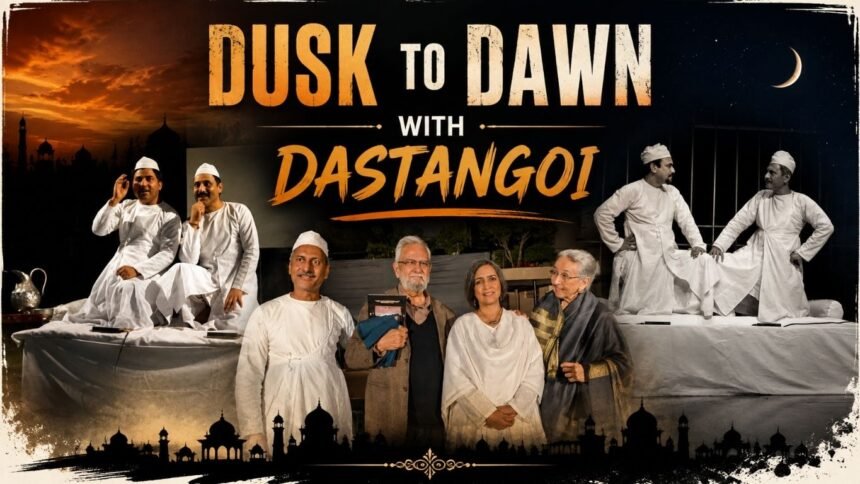
In contrast to the Hamza narratives that were performed with musical accompaniment across the Islamicate world, from Morocco to Indonesia, the Indian Dastangos relied solely on the power of words and the art of storytelling. A single performance required an exceptional mastery of rhetoric, delivery, mimicry, ventriloquism, and spontaneous creation, captivating an audience that could easily lose interest at the slightest dip in engagement.
The last of the eminent traditional storytellers was Mir Baqar Ali, who passed away in Delhi in 1928, just a few years prior to the advent of sound in Indian cinema. He is widely regarded as the final great traditional actor produced by this nation.
He did not merely narrate dastans; he brought to life vivid, dynamic images; or rather, he transformed into a living picture himself. Although he was a slender, slight man, during his recitations, when a king appeared in the tale, the audience felt as if they were in the presence of a formidable sovereign. On Mir Baqar Ali, the last classical Dastango.
Mir Baqar Ali
Mir Baqar Ali Dehlavi (1850–1928) was the last legendary master of traditional Urdu Dastangoi storytelling before the art form faded into a decades-long oblivion. Born in Delhi and trained by his uncle, Ali was a brilliant performer renowned for his extraordinary command of language, phenomenal memory, and ability to weave immersive, “lively moving pictures” using only his voice and minimal gestures. Despite his thin, slightly built frame, he could seamlessly morph into an imperious monarch, a passionate prince, or a toothless old woman, enchanting both public crowds on the steps of the Jama Masjid and royal patrons in princely states. However, as British colonial influence grew and the rise of print media, modern novels, and early cinema (the bioscope) shifted public attention, the rich culture of aristocratic patronage dried up entirely. In his tragic final years, the great storyteller was reduced to absolute poverty, forced to make a living by selling paan (betel leaf) and hawking short, self-written satirical pamphlets. When he passed away in 1928, it was widely believed that the 16th-century art of Urdu Dastangoi had breathed its very last breath alongside him.
Mir Baqar Ali Dehlavi was not merely a passive narrator of tales, but a sharp-witted political satirist and a deeply principled artist who chose to retire rather than compromise the dignity of his craft. In his twilight years, when asked why he had stepped away from the stage, he famously and bitterly remarked, “Where are the listeners of the dastan? In search of my listeners, I will have to go to the graveyard”. He fiercely lamented that the modern citizens of Delhi had lost the refined etiquette, linguistic patience, and cultural sophistication required to appreciate high oral literature. Refusing to cater to a distracted public captivated by the newly arrived colonial “bioscope” (cinema), he redirected his creative genius into writing short, clever pamphlets under colorful pseudonyms like Mala Bakhsh Hathi. One of his most notable publications, Kaana Baati, brilliantly combined scientific descriptions of the human ear with a philosophical critique on the lost “art of paying attention” and listening well. His fearless, biting political commentaries eventually became so potent that two of his self-published pamphlets were officially banned by the British government. His unwavering commitment to the spoken word solidified his status as a legendary cultural resistance figure of Old Delhi.
The Long Silence
At the end of the nineteenth century, a group of reformers reshaped the literary values of Urdu, dismissing what they deemed the “artificial and pretentious” works of earlier times. By aligning literature with social reform and valuing simplicity and authentic experience over creativity, and reflecting Victorian preferences, they established the realist novel as the sole acceptable form of fiction. The Dastan stood in stark contrast, being an anti-novel, and was regarded as childish, inconsistent, implausible, and excessively repetitive.
Religious admonitions had already discouraged readers, particularly women, from engaging with the Dastans; colonial officials deemed them immoral. As cinema adopted many of their elements and the oral tradition that birthed them transitioned to a literary one, the form gradually disappeared from both the literary canon and the performing arts.
Mahmood Farooqui: A new dawn for Dastangoi
Mahmood Farooqui is an acclaimed Indian writer, director, and performer widely celebrated for single-handedly reviving Dastangoi, the ancient 16th-century Urdu art form of oral storytelling. Along with his uncle, the legendary Urdu scholar and critic Shamsur Rahman Faruqi, he reinvented and brought this dying tradition back to the modern stage in 2005. Dastangoi had practically died out in 1928 with the passing of its last great master, Mir Baqir Ali. Mahmood Farooqui conceptualized its modern avatar by introducing dynamic pairs of storytellers (Dastangos) rather than a single speaker, integrating theatrical lighting, and focusing on accessible language.
He has directed and performed thousands of shows globally. Some of his most groundbreaking works include: Dastan-e-Amir Hamza (the traditional, epic medieval narrative), Dastan-e-Karn Az Mahabharata (a unique retelling of Karna’s life using Urdu, Persian, and Sanskrit sources) and Dastan-e-Guru Dutt (a deep cinematic and biographical exploration of filmmaker Guru Dutt). Through his specialized Dastangoi Collective, Farooqui trains a new generation of storytellers to ensure the continuity of the art form.
Farooqui is a highly accomplished historian who studied at St. Stephen’s College, Delhi, and later attended the University of Oxford and Cambridge University as a Rhodes Scholar. He co-directed the critically acclaimed, satirical Bollywood film Peepli Live (2010) alongside his wife, filmmaker Anusha Rizvi. Literature: He is the author of award-winning books, including Besieged: Voices from Delhi 1857, which translates historic documents from the Indian Rebellion.
Mr. Farooqui asserts that Dastangoi possesses limitless potential to evolve into a highly favored form of entertainment in India. “It necessitates minimal infrastructure to perform Dastangoi – merely a seating area, microphones, and a few candles to impart an old-world ambiance. People are becoming increasingly intrigued as it offers a stark contrast to reading a story, with significant voice modulation involved,” he stated.
Dusty Decades
In 2015, the esteemed scholar and stage artist Mahmood Farooqui was incarcerated in Tihar for a crime he consistently denied, and he was ultimately acquitted under circumstances that remain contentious. During his time in prison, it was his faith, along with literature, theater, and writing, that rekindled his will to survive. Through this profoundly personal memoir, he addresses the most harrowing period of his existence. “It represented the lowest point of my forty-four years—emotionally, physically, intellectually, and socially,” he reflects.
Born in Gorakhpur in 1971, Mr. Farooqui experienced a humble, middle-class upbringing. Although he was emotional and determined as a child, he demonstrated a strong work ethic, earning the Government of India Merit Scholarship to attend The Doon School in Dehradun. He characterizes his early years there as traumatic, which instilled in him significant insecurities and diminished self-worth. Concurrently, he excelled as a debater, athlete, mathematics prodigy, and theater director.
Following his schooling, he pursued a degree in history honors at St Stephen’s College. Subsequently, he was awarded the Rhodes Scholarship and attended Oxford. Upon his return to India, he briefly worked as a television news reporter, during which time he met his future spouse, Anusha Rizvi. After their marriage, he began to revive Dastangoi, the forgotten art of Urdu storytelling. In 2010, their film, Peepli Live, was released and achieved cult status. Around this period, Mr. Farooqui also published his book, Besieged: Voices from Delhi, 1857.
Despite his busy schedule, Mr. Farooqui acknowledges a certain estrangement from his wife, grappling with depression and succumbing to his addictions. During this period, he frequently met an American researcher over drinks. In June 2015, Mr. Farooqui was unexpectedly arrested on rape charges brought forth by the American scholar. He was taken into custody and subsequently sent to Tihar.
His arrest, a contentious and highly publicized matter, garnered significant media attention. Although his connection to the film industry lent a hint of glamour within the prison walls, he faced ritual abuse and humiliation. “Hope is reckless inside prison,” he reflects. After approximately two weeks, Mr. Farooqui performed a Dastangoi in prison, which many found enjoyable. He also began to voraciously read the collection of books available in the jail’s library.
Mr. Farooqui provides a detailed account of various facets of Asia’s largest and most renowned jail — including its food, atmosphere, fellow inmates, and their backgrounds. He observes that while Tihar’s official capacity is 6,000, the actual number of inmates exceeds 14,000. He notes that there are no peons or sweepers in this efficiently managed facility; instead, inmates perform free labor — transporting groceries, preparing meals, cleaning, and providing security. He came to understand that many murderers are “accidental villains,” having committed crimes driven by passion.
During his time in prison, Mr. Farooqui made several profound observations, which he recorded in his journal. He remarked that witnessing another person’s degradation is both the most repulsive and captivating sight that the prison has to offer. He further states that while inmates are sent to prison as a form of punishment, they often endure additional suffering while incarcerated. “Everywhere I turned, I found sorrow, anguish, and helplessness,” he explains.
After being released on interim bail, Mr. Farooqui was convicted and sentenced to seven years, leading to his return to Tihar in 2016. This time, he resolved to initiate a drama class within the prison, starting with a series of workshops, which eventually evolved into small improvisational skits based on the inmates’ own life experiences. The task proved to be quite challenging, particularly as the majority of the prisoners lacked literacy skills and any prior experience in theatre.
After enduring 18 arduous months in prison and engaging in a legal battle that lasted three years, Mr. Farooqui states that the assaults against him persist even now. Social media posts label him a rapist, and many individuals hesitate to invite him to their events due to the intimidation from a small yet vocal group. Remarkably, within a month of his release, Mr. Farooqui returned to the prison as an instructor. He maintains contact with the inmates, assisting with their cases, depositing funds into their accounts, and providing them with counsel. He firmly believes, “People shouldn’t have to pay for a rash, momentary mistake with years of torture.”
To this day, Mr. Farooqui has authored 15 contemporary dastans, directed several productions, and performed in over a thousand shows globally. It is evident that writing this courageous memoir was a formidable task, taking him a decade to share it with the world.
In contrast to memoirs authored by political prisoners, Farooqui’s narrative emerges from a profound sense of personal shame and societal vulnerability, effectively discarding the facade of middle-class respectability. He recounts the establishment of an unlikely theater workshop with inmates—many of whom had no prior experience in acting or script reading—who participated in search of fundamental respect and human acknowledgment. The book emphasizes how engaging with Russian literature, memorizing epic poetry, and storytelling rejuvenated his desire to live amidst severe depression.
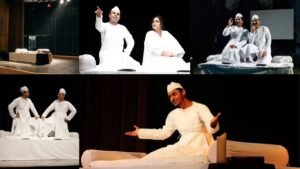
Deeply Drawn Dastangoi
Indian Women Dastangos
Indian women storytellers have sought acknowledgment by entering traditionally male-dominated art forms such as Dastangoi, successfully navigating social, cultural, and gender-related barriers. Trailblazers like Fouzia Dastango and Poonam Girdhani confronted stereotypes, performed without professional backing, and employed personal stories to emphasize feminism and social concerns, ensuring that women’s voices were amplified. Female storytellers, especially in the historically male-centric field of Dastangoi, encountered considerable challenges, including doubt and societal expectations. The fabled art of Dastangoi has seen a revival in India in recent years, but it has largely remained a male-dominated profession. Two female dastangos (storytellers) who are challenging the norm narrated their journeys.
FAUZIA DASTONG
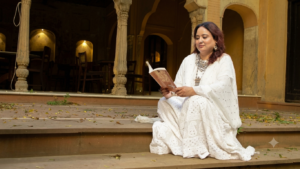
Fueled by their passion for storytelling, Fouzia and Poonam have shattered barriers to enter the traditionally male-dominated realm of dastangos (storytellers). Frequently attired in immaculate white, they delight in whisking a group of strangers away to a magical realm of narratives, all conveyed through flawlessly spoken Urdu.
Fouzia, who doesn’t use a surname and is in her late 30s, says stories fascinated her when she was a child growing up in Delhi. Her mother would often warn her that “cooking up stories will land you in trouble” but she wanted to “read every single story book” that her motorbike mechanic father could afford. Fouzia’s mother often read to her stories from great Urdu classics and that fired her imagination. Today, Fouzia Dastango, recognized as the first female Urdu storyteller and most most popular dastangos in Urdu. Her craft involves oral telling of stories of adventure, magic and warfare.
Artists such as Fouzia Dastango, challenged the traditional norms regarding who is permitted to narrate stories of adventure and conflict. She frequently emphasized and highlighted narratives centered around women, particularly those stemming from the partition of 1947, as well as works by feminist writers like Ismat Chughtai. These women often utilized Begamati zabaan (the women’s language of Old Delhi) to preserve a unique cultural voice, reinforcing their identity and resisting the exclusion of their narratives.
With deep emotion and a heartfelt tone, Fouzia expresses her thoughts, “I pursued my studies in Urdu during my school years to enable myself to read all the classic literature. I was certain that I needed to channel my passion for the realm of fantasy into something more significant. I opted for a career in Dastangoi instead of accepting a lucrative job, and my family supported me throughout this journey. However, I made the decision to resign from my job in order to receive training in Dastangoi from historian and author Mahmood Farooqui, who is recognized for his efforts in reviving this lost art form in India”.
Once again, she fervently articulated with a voice filled with saudade, “During that period, it was indeed quite challenging for me to overcome the stereotypes associated with being a Muslim woman. Furthermore, I encountered difficulties in penetrating this male-dominated sphere and still recall that the audience was ‘taken aback to witness a woman dastango when I delivered my inaugural performance in 2006. Women traditionally shared their stories within the confines of their homes and never in public. However, I have endeavored to alter this norm and have successfully conducted 88 performances across the nation thus far. I chose not to wear the hijab or the burka, which initially surprised people, but they gradually came to accept me.
POONAMA GIRDHANI
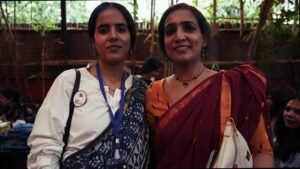
Renowned theatre and film actress Poonam Girdhani has a diverse involvement in the performing arts. She has extensively engaged in various media, including Television, Film, Radio, and Theatre. Her proficiency in multiple languages such as Urdu, Hindi, English, and her native Sindhi has allowed her to contribute to and enhance theatrical productions from various theatrical environments and traditions. Active in theatre since 1994, she has collaborated with prominent theatre groups in India, including Naya Theatre (under the direction of Habib Tanvir), Chingari, Asmita, and Bahroop. Her international experience encompasses work with Heiner Muller’s group from Germany. For over a decade, she has served as a Dastango, performing at events such as Jashn-e Rekhta, Habitat, the Jaipur Literature Festival, and in numerous other cities and towns across India. She has partnered with Ankit Chadha to debut several children’s stories, including Dastan Alice Ki and Dastan Little Prince Ki.
She has gathered numerous folk tales and children’s stories for the Dastangoi format and has authored Dastan e irfan e Buddha, in addition to adapting Dastan Haroun ki, which is based on Salman Rushdie’s Haroun and the Sea of Stories. In an effort to revitalize the tradition of storytelling for children, Poonam plays a significant role in the Dastangoi team for this genre. “Children are undoubtedly more receptive. Their reactions are much more heartwarming, yet they also present a challenge, as it requires greater effort to engage them. The greatest reward for a dastango is the ability to transport the audience to another realm where the story unfolds, recreating the magic solely through the power of words,” Poonam states.
Poonam was introduced to the realm of Dastangoi by Mahmood Farooqui, a dastango based in Delhi, who is a writer, director, theatre historian, and the founder of the Dastangoi Collective. He is recognized for revitalizing this art form, which had fallen into disuse since 1928, following the death of the renowned dastango Mir Baqar Ali. The productions by the team encompass narratives related to the Mahabharata, the Partition, Rama, and Rabindranath Tagore. In the 16th century, the life and times of Amir Hamza, who is believed to be an uncle of the Prophet Mohammed, emerged as popular subjects for Dastangoi. The Dastan-e-Amir Hamza, published in Calcutta during the 19th century, spans over 46,000 pages. A dastango can be a story within a story, a chapter within a chapter, and a loop within a loop, making it potentially endless and perpetually engaging, provided the dastango is skilled.
During her childhood, Poonam was significantly influenced by her maternal grandfather, a freedom fighter and poet who composed in Urdu. “The Urdu words continuously resonated in my ears, as did the exquisite Hindi of Bikaner,” she recalls. Her proficiency in Urdu saw remarkable improvement after she became a member of playwright Shahid Anwar’s theatre company, Bahroop Arts Group. Eventually, they married, and she attributes her newfound confidence in pursuing her own career and voice to him. However, his unexpected passing in 2015 brought Poonam to the edge of despair.
Coming to terms with the reality of being a single mother was quite challenging. However, Dastangoi and her workshops in educational institutions kept her occupied. In 2018, Mahmood Farooqui invited her to compose a dastan (story) about Gautama Buddha. She felt uncertain as she had never attempted to write one before. It was fortuitous that she visited Aurangabad during that time. “The narratives depicted on the walls of the Buddhist caves in Ajanta captivated me. The illustration of the young girl Sujata, who offers rice porridge to a starving man, unaware that he is the future Buddha, profoundly moved me. I believed it was essential to share these stories.”
Poonam’s research commenced with the Jataka tales, where she discovered that she was engaging with abridged and translated versions that included a contrived moral conclusion. She explored the writings of Buddhist polyglot and polymath Rahul Sankrityayan, Pakistani author Intizar Hussain, political theorist Kancha Illaiah, and Dr. B. R. Ambedkar. Additionally, she examined translations of the Therigatha, a collection of narratives composed in verse in Pali by elderly nuns, which stands as the earliest known anthology of women’s literature created in India. “This prompted me to address the issue of women’s protection, which was a significant aspect of the Buddha’s teachings. Delving into his life and experiences led me to reflect on my own recent losses, aiding me not only in coping but also in looking forward. Besides Urdu and Hindi, I have incorporated lines in Pali and Sanskrit into my script. Now, I aspire to learn Pali!”
Poonam’s performance on Buddha’s dastan
The dastan (story) commences with an apology and a Jataka tale. It is autumn, and Buddha is journeying through a jungle with his disciple Anand when he gathers a few leaves. He inquires, “Do I possess all the leaves in the forest within my grasp?” This question astonishes Anand, who responds, “What are you saying, Tathagat? This jungle is vast, and it is autumn; how can you hold all the leaves in your hand?” It is at this moment that Buddha replies, ‘Similarly, there are many truths scattered around; I am offering you whatever I could collect in my hand.’ In a similar manner, dastangos Poonam and Rajesh Kumar gather fragments from Buddha’s life and teachings and present them in the form of Dastan-e-Irfaan-e-Buddh.
Poonam has been practicing Dastangoi, a form of storytelling in Urdu, for the past five years; however, this is the first time she has authored a dastan, which has been in development since October 2018. “When you explore Buddhist literature, it often addresses the concept of loss and how life and death are two significant truths in existence. I have recently experienced the loss of many close individuals, and through the process of reading, I was able to process that loss as well,” she explains.
The Jataka tales provided her with a means to cope, and she subsequently progressed to reading the works of Pakistani author Intizar Hussain, who was significantly influenced by Buddhism, with these stories being integral to his writings. “There are numerous sources to familiarize oneself with Buddha. You can encounter him in the Jataka tales, and in the modern era, he is present in the writings of BR Ambedkar and Kancha Illiah. When Hussain depicts Buddha, he presents him with a fresh perspective and vibrancy. It becomes evident how the Jataka tales held as much significance in 1947 as they did 2,500 years ago,” states Girdhani, who has also woven in languages such as Pali, Hindi, and Sanskrit, in addition to Urdu, within the dastan. “What I learnt about Buddha was how he practised meditation. Nowadays, we want an empty and silent room, but for him, meditation was about being present in the moment; even when you’re eating, you should experience each morsel, or when you’re walking, you should be aware of your movement,” she says.
What she cherished about the Jataka tales was the way in which women, men, trees, lizards, and plants each possessed their own unique identities and embarked on their journeys collectively. “However, the most fascinating aspect I delved into was the Therigatha — a compilation of poems and songs authored by women nuns that unveil a parallel universe. They communicate with their eyes and their mental frameworks. Illiah is among the few who addresses this in his writings. He highlights the stories of Dalits and women in the context of Buddhism. In contrast, Ambedkar discusses the rationality of Buddhism, asserting that for him, it represents a religion grounded in science.
Poonam, who has previously performed in Dastan Raja Vikram ke Ishq ki, Dastan-E-Chauboli, and Dastan Alice ki, had to unlearn certain aspects of her theatre training in order to write dastan. “My background is in theatre, so I tend to think in terms of sequences and pauses. When I began writing, I was uncertain about how to begin. Eventually, I understood that the key is to narrate the story rather than perform it on stage. The greatest reward for a Dastango is the ability to transport the audience to a different realm where the story unfolds, recreating the enchantment solely through the power of words,” said Poonam.
Dastangoi in the Age of AI
The narrative of Dastangoi in India exemplifies a tale of both loss and resurgence. For centuries, the Dastango—the storyteller—captivated audiences using merely his voice, memory, gestures, and linguistic prowess. At the heart of this vast storytelling realm was the Dastan-e-Amir Hamza, a legendary saga that ultimately comprised forty-six printed volumes and approximately 46,000 pages. However, this tradition gradually faded from public consciousness, and with the passing of the renowned classical Dastango Mir Baqar Ali in 1928, the living transmission of this art form was effectively severed. For nearly eighty years, Dastangoi existed primarily as a literary relic rather than a vibrant performance tradition.
The remarkable resurgence of Dastangoi commenced in 2005, when writer and theatre practitioner Mahmood Farooqui, with the support and guidance of Urdu critic Shamsur Rahman Faruqi, presented a contemporary rendition of Tilism-e-Hoshruba. What began as an experimental endeavor gradually evolved into a movement. Over two decades later, the Dastangoi collective reports that more than fifty performers have been trained, and the art form has graced over a thousand stages both in India and internationally. Yet, this success prompts an intriguing and somewhat unsettling question: has Dastangoi truly been revived, or has a new theatrical genre emerged under the guise of an ancient tradition?
This inquiry transcends mere academic interest. The original Dastangoi was an oral tradition upheld through memory, apprenticeship, and live performance. In contrast, the modern revival has inevitably reconstructed the form using manuscripts, scholarly research, and theatrical creativity. Farooqui has articulated that contemporary performers engage with segments of the extensive published texts, condense them into coherent narratives, and rehearse them for present-day performances. The incorporation of two performers, modern themes, and innovative theatrical frameworks has also transformed the traditional format. In this context, the contemporary Dastangoi cannot be classified as merely a museum-like reconstruction or a direct continuation of the nineteenth-century tradition. It represents a more intricate phenomenon: a modern theatrical language that has emerged from the remnants of a lost oral tradition.
This reinvention is particularly evident in the themes being explored. The current Dastango no longer solely narrates tales from the fantastical realms of Amir Hamza, Amar Ayyar, and Tilism-e-Hoshruba. Instead, Dastangoi has been employed to recount stories related to Partition, Gandhi, Bhagat Singh, Karna, Manto, Ghalib, and various other historical and literary figures. Consequently, the form has transcended a significant threshold—from merely preserving an ancient repertoire to serving as a medium for interpreting India’s historical and contemporary narratives. A storytelling tradition once renowned for its magic, adventure, warriors, tricksters, and enchanted realms is now equipped to pose inquiries regarding nationalism, memory, violence, identity, and dissent. This may indeed be the most compelling indication of the form’s vitality: a stagnant tradition merely reiterates its past; a vibrant tradition engages with its present.
However, there exists another risk—the “festivalisation” of Dastangoi. Its inclusion in literary festivals, theatre festivals, heritage programs, and cultural events has undoubtedly attracted new audiences. Recent performances, such as Dastan-e-Simurgh, showcased at the 2026 Mahindra Sanatkada Lucknow Festival, illustrate that audiences can still be enthralled by a storyteller without the need for elaborate sets or visual effects. Nevertheless, the success of festivals can also lead to a paradox. As Dastangoi increasingly becomes a curated cultural experience for urban literary and theatre audiences, there is a heightened risk that an art form once deeply rooted in popular public culture may be reduced to a heritage consumed by a cultural elite. The concern is not that festivals are promoting Dastangoi; rather, the real danger lies in the potential for the festival stage to become its primary environment, relegating the broader public to the role of mere spectators instead of active participants in its cultural narrative.
This leads us to perhaps the most intriguing question of all: what does Dastangoi signify in 2026, a time when artificial intelligence can create an image, a voice, a character, a landscape, and even an entire narrative in mere seconds? At first glance, AI seems to be the natural adversary of an ancient oral tradition. However, the reality may be quite the opposite. AI can present us with a fantastical realm; Dastangoi encourages us to envision one. AI can generate countless faces; the Dastango can evoke those faces through variations in voice, rhythm, and gesture. AI can deliver spectacle almost instantaneously; Dastangoi invites the audience to sit in silence and construct the spectacle within their own minds.
This distinction may grow increasingly significant. In an era of endlessly produced images, Dastangoi provides something that technology cannot replicate in the same human manner: the collective act of imagination shared between a living storyteller and an attentive audience. The bare stage does not signify a lack of technology; rather, it represents a conscious relinquishment of technology, allowing the listener’s imagination to become the stage. Therefore, the future of Dastangoi may not reside in competing with cinema, streaming services, or AI-generated narratives. Its future may lie precisely in delivering what those technologies cannot easily substitute—the warmth of a human voice, the unpredictability of live performance, and the unique intimacy of numerous individuals envisioning the same unseen world together.
This places Dastangoi at a remarkable crossroads. It has emerged from silence, but not in the exact form in which it vanished. It has been revitalized, yet also transformed. It has participated in festivals, but must steer clear of becoming merely a festival relic. In an age where machines can fabricate stories, its greatest asset may ultimately be the most ancient technology of all—the human voice conveying to another human being, ‘Listen, and imagine.’
(The views expressed here by the author are his own. If there is any counterview it may please be shared with the Chief Editor at samadrusti@gmail.com)
Comments
0 comments