
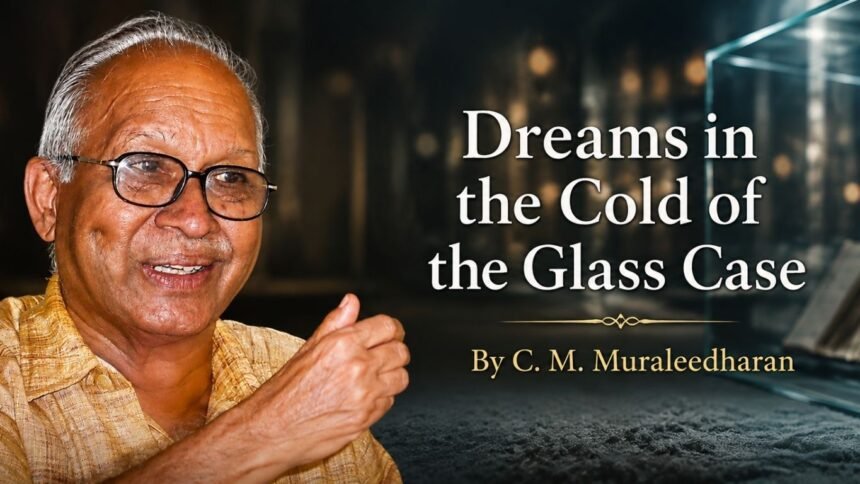
M. P. is lying there with his eyes closed, in the cold of the glass case. I watched him for a while. Then, like a flash, another memory came into my mind from somewhere.
It must have been years ago, at the Kayyur conference in Kasaragod district—or at least, I think so. I am not quite certain. The preparations for the conference were going on late into the night. We were looking for a place to sleep. On a mat spread out in the verandah, someone was sleeping, wrapped completely in a white cloth. He had covered himself up to escape the mosquitoes buzzing around him. He looked exactly like someone lying in state.
Without knowing who it was, I remarked rather playfully, “Who on earth is this?”
“That’s M. P., man,” someone who was with me completed the answer.
Yes. It was none other than M. P. Parameswaran, whom everyone, irrespective of age, simply called M. P. He was sleeping in a school verandah with his mundu pulled over him as a blanket.
From former President K. R. Narayanan and senior officials at the highest levels of the Central Government to farmers in the villages of Kerala, people addressed him as M. P. Even children, including my daughter, called him “M. P. Maman.”
I first met M. P. in 1985, in a room with only half-height walls at Thiruvangoor High School. He was wearing a short-sleeved shirt made of handloom cloth. Calling it a shirt would perhaps be an exaggeration; “vest” would be more appropriate. Thick spectacles. Someone introduced him to me, a newcomer to the movement, as Dr M. P. Parameswaran.
It was a three-day Parishad school for activists from Wayanad and Kozhikode districts. M. P. was the headmaster. Everyone in the class was a senior activist. Some carried strong political convictions. I was the only one with a fledgling moustache.
What I heard there was entirely new to me. M. P. spoke about a wide range of ideas—from providing farmers with free motors to pump groundwater, to perspectives on the environment, development, energy and education. Many argued with him. I listened, astonished and overwhelmed.
Even during our evening walk to Kappad beach, M. P. kept talking. There were abundant kakkathodukal—the wild shellfish found along the roadside. He kept asking questions about them too. I could not answer many of them and was left completely bewildered.
Every sight along the way was something M. P. could assess in terms of its value, and then convert into labour-days and possibilities. All the calculations were done in his head. The way he performed those mental calculations was astonishing.
From coconut cultivation to food processing, from smokeless stoves to watershed management, from transformer-centred power-line mapping to comprehensive energy planning for Kerala—there seemed to be no field beyond the reach of M. P.’s imagination.
Dreams and calculations filled his life. The millions of literacy instructors and organisers who came together across India were born of some of those dreams—and some of those calculations.
The Bharat Gyan Vigyan Jatha, a vast project that many would have hesitated even to imagine, was something M. P. dreamed up: a movement that would reach the remotest corners of India, the places where even the proverbial crow would not venture. Perhaps “the most inaccessible corners of India”—or another phrase suited to the place—would be a better way of putting it.
Cultural processions stretching from the southernmost tip of India to the north. Thousands of centres. M. P. travelled across the length and breadth of the country. In places where there seemed to be no one, he found people. That was how the slow-moving literacy movement in India acquired a new dynamism.
M. P.’s circle of communication extended from Parishad unit-level activists to eminent scientists. He would constantly visit scientific and technological institutions in Kerala and elsewhere. He would engage the people there in discussions and assign each of them something to do. In this way, many people acquired what M. P. called mottakadi—the itch, the restlessness, the inability to sit still that drove Parishad work.
None of these discussions or assignments came out of any committee decision. At times, the assignments he gave even came into conflict with the organisation’s established line. What excited M. P. was speed—the speed of action.
He was not someone who calculated everything meticulously before daring to stick his head into a gap. Rather, he was constantly dissatisfied that the Parishad’s activities were not moving fast enough. “There isn’t enough speed, there isn’t enough speed,” he would keep complaining. He quarrelled with those who dragged their feet. He could be stubborn about some things.
“Tomorrow will be too late” was not merely the slogan of the literacy movement. It was the very essence of M. P.’s philosophy of life.
Those who became office-bearers of the Parishad would have to endure a flood of notes from M. P. He would write down his opinions and suggestions on almost everything and send them to them. In the beginning, these were handwritten. Later, with the help of others, they took the form of PDFs.
M. P. kept a copy of every note he wrote at home. Ideas that had failed to materialise would be reborn as notes when an appropriate occasion arose.
There may not have been anything particularly captivating or theatrical about his public speeches. But they were to the point and crystal clear.
The Ernakulam literacy programme, followed by development marches centred on decentralisation, and the Kerala Literacy programme together formed an extensive programme of action that was approved by a special General Council meeting held in Thrissur.
I can never forget the presentation M. P. made there, lasting about forty-five minutes, on “The All-India People’s Science Movement and the Immediate Tasks Before the Parishad.”
When my book on language planning was published, I entrusted a friend, P. Murali, with the task of getting a copy to M. P.
Later, I called M. P. and asked whether he had received the book.
“What’s the use of getting it?” he replied.
By then, his eyes were no longer suited to reading.
“Do one thing. Prepare a one-page note about the contents and send it to me. I’ll try to enlarge it on the computer and read it.”
I sent him the note, but I could not rest easy. I called M. P. again. I read the entire note aloud to him. In the course of it, he asked for explanations of one or two words that were unfamiliar to him.
After that, I had only one more opportunity to go to Thrissur and speak with M. P. That day he asked me about my research.
In his autobiography, M. P. mentions having lost a file that he had kept during his days at the Language Institute. That loss probably saddened me more than anyone else. The file would have been immensely useful for my own study of the Institute.
M. P. taught us not merely to dream while asleep, but to dream while awake as well—and to pass those dreams on to others.
Even in the face of the frailties of old age, M. P. continued to dream. With the help of others, he put those dreams into writing.
A mind that never dimmed.
Even in the cold of that glass case, M. P. must be dreaming. He must be thinking.
Dreams that time may fail to recognise.
By
C. M. Muraleedharan
( CM Muraleedharan is former General Secretary of KSSP)
Comments
0 comments