
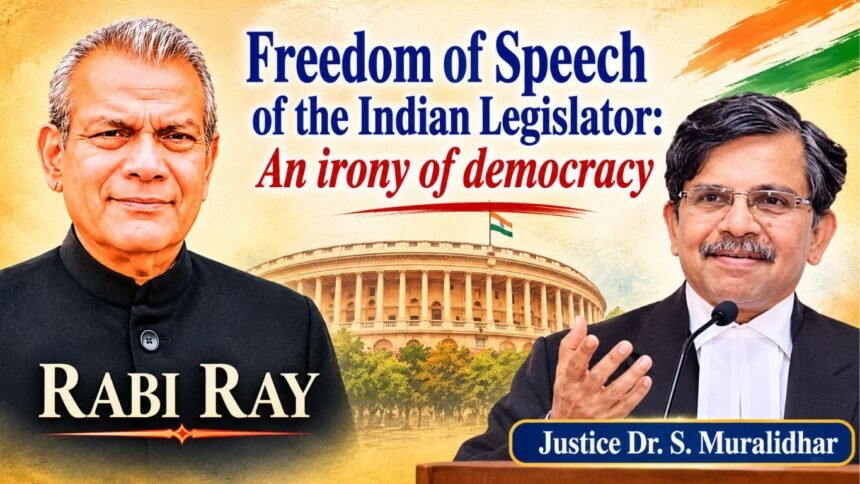
Justice Dr. S. Muralidhar retired as Chief Justice of Odisha High Court. He is currently heading the Independent International Commission of Inquiry on the Occupied Palestinian Territory as its Chairperson.
It is an honour and a privilege to be asked to deliver the Rabi Ray Centenary lecture to commemorate one of India’s finest parliamentarians, and above all, one of most conscientious Speakers of the Lok Sabha. A socialist throughout his active political life, Rabi Babu was an epitome of simplicity and unshakeable integrity which endeared him to everyone who knew him. He has inspired several generations of committed socialists believing in constitutional values and to preserving a democratic way of life. India needs many more Rabi Rays to regain independence for its democratic institutions, particularly the legislatures. *
I
Prologue
3rd May 1880 is an important date in the history of Parliaments. A recently elected independent candidate from the Northampton constituency was to be administered the oath before he took his seat in the House of Commons in England. He insisted on being permitted to ‘affirm’ i.e. not be compelled to swear in the name of God. The other Members of Parliament (MPs) would have none of it. They succeeded in blocking him despite his relenting to take the oath. Their reasoning was that since he was a proclaimed atheist, which he was, an oath even if taken would not bind him. Since he did not take his seat, it fell vacant. When Northampton was asked to again elect, its constituents elected the same person. And so it went on for four consecutive times over a period of six years. Ultimately, this MP was permitted to take his seat in 1886 after being sworn in. Within two years he got an Affirmation Bill passed. The Oaths Act as amended in 1888 now stated that “every person upon objecting to being sworn and stating as the ground of such objection either that he has no religious belief or that the taking of an oath is contrary to his religious belief shall be permitted to make a solemn affirmation instead of taking an oath in all places and for all purposes where an oath is or shall be required by law which affirmation shall be of the same force and effect as if he had taken the oath.”
So who was this historic personality whose close associate was Annie Basant and at whose funeral in 1891 a young Indian Barrister named Mohandas Karamchand Gandhi was in attendance? This fiery debater was Charles Bradlaugh. He was singularly, and through his persistent efforts for over eight years, responsible for the change in the oath administered to legislators across the commonwealth. This is the background to the form of oath administered to all constitutional authorities, in terms of the Third Schedule to the Constitution of India. The oath taker has a choice. Either to swear in the name of God or to solemnly affirm. This is significant because these are the first spoken words by every legislator upon getting elected or nominated to a legislature in India.
II
So what is the significance of Bradlaugh’s historic fight to the topic of today’s lecture? In a democracy governed by the rule of law, the legislature is the constitutionally recognised organ of State that permits the voices of the people to be heard through their elected representatives. In India this is the Parliament – comprising the House of the People (Lok Sabha) and the Council of States (Rajya Sabha) – and State legislature comprising the legislative assemblies and legislative councils. The speeches of Bradlaugh in defending his demand to affirm and in voicing his protest at being denied that request makes it clear that the essential function of an MP is to speak for his constituents and to speak fearlessly. Secondly, and most importantly, the MP should be aware that without the constituents they would have no locus standi in the legislature. It is to the constituents that the legislator is primarily responsible. Bradlaugh reminded the House of Commons: I have no fear. If I am not fit for my constituents they shall dismiss me, but you never shall. The grave alone shall make me yield.” So when an MP speaks differently in the house from what he held out to his constituents, it would be a betrayal of trust. More on this later. The third point of relevance is that Bradlaugh also took his fight to the courts and that resulted in the landmark verdict of the House of Lords in Bradlaugh v Gosset which recognised that in the matters of regulating the procedure within the house it is the legislature that is supreme and the courts will stay off. This holds good still for the Indian legislatures since, despite 76 years of the Constitution, they still follow the same procedures and practices and adopt the same privileges as are available to the MPs of the House of Commons.
III
Legislative Privilege and its breach
Article 105 (1) of the Constitution of India grants to an MP freedom of speech in Parliament, “subject to the provisions of this Constitution and to the rules and standing orders regulating the procedure of Parliament”. Article 105 (2) states that no MP shall be liable to any proceedings in any court in respect of anything said or any vote given by him in Parliament or any committee thereof and no person shall be so liable in respect of the publication by or under the authority of either house of Parliament of any report paper votes or proceedings. This would include the committees both sub-committees and ad hoc committees of Parliament. The corresponding provision as far as state legislatures is concerned is Article 194.
The legislative privilege therefore works at two levels. At the individual level it is the right of a legislator to freely speak, subject to restrictions spelt out in the Constitution, and to enjoy a degree of immunity as spelt out in Article 105 (2). At the institutional level, the legislature is supreme in its domain. It has the last word on how to regulate the proceedings of the house, pull up persons for breaches of privilege and punish those in contempt. There is a distinction that requires to be drawn between a ‘breach of privilege’ and a ‘contempt of the legislature’. While the procedure adopted to deal with both may be similar, the former connotes an infraction of powers, immunities and specific rights granted to the legislature or its members, the latter i.e. contempt is stated to occur when the act in question impedes or obstructs an MP or the proceedings or brings the legislature as an institution into disrepute. Every action constituting a breach of privilege would constitute a contempt of the house but the converse is not necessarily true. Publishing confidential reports of committees or arresting an MP in a civil case during the session of the legislature would constitute breach of privilege. Shouting from the visitors’ gallery, throwing objects into the house, unruly behaviour, refusing to obey summons to appear before the house or a committee, would be examples of contempt.
So is an MP free to speak whatever he or she wishes while in Parliament? The answer to that has to be in the negative. The practice and procedure of the Indian Parliament, which is a compilation of nearly 1000 pages, sets out, among many other things, what can and cannot be spoken, when and how. First of all an MP has to notify to her own party, her intention to speak.
The party then submits a list to the Speaker in the case of the Lok Sabha, and the Vice-President who is the Chairman of the Rajya Sabha. Time is allocated to the parties, both in the Treasury benches and in the opposition, according to the relative strength of MPs. That time then has to be divided among the speakers. It may be possible that a speaker on the list may not be called upon by the Speaker due to lack of time or simply because the house has had to adjourn. There are all kinds of rules, some of which are to say the least, strange. For e.g., In the interest of decorum and dignity of the House, members are required not to indulge in any flippancy, including knitting by women members.And, ‘Members are also not to talk or crack jokes with each other’!!! The requirement, which makes eminent sense, and which is observed in its breach is this: ‘A member having a personal, pecuniary or direct interest in a matter before the House is required, while taking part in the proceedings on that matter, to declare the nature of that interest.’
IV
Unparliamentary Words and Censorship
Apart from the time constraint, there is also a formal system of ‘censorship’ of what can be spoken and what can be allowed to go on record. If the words spoken in the house are defamatory or indecent or unparliamentary or undignified, the Speaker has the discretion to order that such words be expunged from the proceedings of the House. So what are these unparliamentary words? These have been compiled over the years and there are more than a thousand such words, both in English and in Hindi which when viewed individually per se can hardly seem objectionable. For e.g.,like ‘jumlajeevi’, ‘Baal buddhi’, ‘Covidspreader’ and ‘Snoopgate’ and even commonly used words like ‘ashamed’, ‘abused, ‘betrayed’, ‘corrupt’, ‘drama’,’hypocrisy’ and ‘incompetent’ were considered unparliamentary in both the Lok Sabha and Rajya Sabha. Among some of the English and Hindi words listed by the Secretariat as unparliamentary are: ‘ashamed’, ‘abused’, ‘bloodshed’, ‘bloody’, ‘betrayed’, ‘cheated, ‘chamcha’, ‘chamchagiri’, ‘chelas’, ‘childishness’, ‘corrupt’, ‘coward’, ‘criminal’ and ‘crocodile tears’. Routine English words like ‘disgrace’, ‘donkey’, ‘drama’, ‘eyewash’, ‘fudge’, ‘hooliganism’, ‘hypocrisy’, ‘incompetent’, ‘mislead’, ‘lie’, ‘untrue’ and even ‘sexual harassment’ have been included in the list. The Hindi words listed as unparliamentary include ‘gaddar’, ‘girgit’, ‘goons’, ‘ghadiyali ansu’, ‘apmaan’, ‘asatya’, ‘ahankaar’, ‘kala din’, ‘kala bazaari’, ‘khareed farokht’, ‘danga’, ‘dalal’, ‘daadagiri’, ‘dohra charitra’, ‘bechara’, ‘bobcut’, ‘lollypop’, ‘vishwasghat’, ‘samvedanheen’, ‘pitthu’, and ‘behri sarkar’. These words are commonly used in ordinary conversations. Hardly anyone would consider the use of such words objectionable.
No doubt the compilations themselves state at the outset that some of the keywords may not appear unparliamentary unless read in conjunction with the other expressions spoken during the parliamentary proceedings. But, there is no real guidance in the compilations about the ‘whole context’ in which these words would be found to be ‘unparliamentary’. Even the stray examples given offer no help. For e.g., for the use of the word ‘false’ the following sentence was found objectionable: “Here the point is to implement that whether the lollipops given in the budget, the false promises made in the budget reach to the people in right manner or not.” And for the use of the Hindi word gundas the following context is provided (in a truncated manner) “….The big upper caste gundas to rape the innocent dalit girls…”. These examples tell us that we must be either fetishised or hypocritical to find these expressions to be unacceptable. And compared to the legislatures of other countries, it does appear that we are.
Parliaments in European countries appear to be prepared to give a greater leeway to the use of language that is either disrespectful or irreverent. To call a Minister as “stupid”, “most stupid” and “unsurpassed and unpredictable … stupidity”, was viewed by the European Court of Human Rights as provocative, caustic and even insulting. However, on the basis that journalistic freedom allows for exaggeration and even immoderate statements, the descriptions were seen as subjective value judgments not attracting the law of contempt. We should recall the words of Napoleon Bonaparte who is supposed to have remarked: In politics, stupidity is not a handicap. In another instance, the description of a politician as an ‘idiot’ was said not to attract action as it was provoked by his own speech. The principle explained was this: “ the limits of acceptable criticism .. are wider with regard to a politician acting in his public capacity than in relation to a private individual. A politician inevitably and knowingly lays himself open to close scrutiny of his every word and deed by both journalists and the public at large, and he must display a greater degree of tolerance, especially when he himself makes public statements that are susceptible of criticism.”
An earlier generation of legislators knew how to take criticism and perhaps had a better and healthier sense of humour.
Once while rejecting an amendment moved by Rajaji, Nehru said: “You see, Rajaji, the majority is with me.” Rajaji countered: “Yes, Jawaharlal, the majority is with you, but the logic is with me”. Nehru laughed with the House, realised that Rajaji had a point and the amendment was carried out.
Self-deprecation was another way of easing the pressure valve. On one occasion, Piloo Mody was censured for showing negligence to the seat by talking with his back to the Speaker. Mody shielded himself by saying, “Sir, I have neither front nor back, I am round.” The same gentleman was accused by the ruling Congress party as being a Washington parrot since he held pronounced conservative and pro-American views. So Piloo Mody came to the House wearing a placard reading ‘I am a CIA agent’. The chairman ordered him to remove it. He did so, remarking, ‘I am no longer a CIA agent.’ Once, when J C Jain, a Congress MP kept heckling and taunting him, Piloo Mody lost his temper and shouted, ‘Stop Barking!’. Jain was up on his feet yelling, ‘Sir, he’s calling me a dog. This is unparliamentary language.’ Chairman Hidayatullah agreed, and ordered, ‘This will not go on record.’ Not to be outdone, Piloo Mody retorted, ‘All right then, stop braying.’ Jain did not know what the word implied. It stayed on record.
By convention, no allegation or criticism is made in the legislature against heads of foreign diplomatic missions. As regards allegations by one member against another, the five conditions are that the member must give adequate notice; state precise charges supported by authenticated documents; satisfy himself by inquiry that there is a basis; accept responsibility; and be prepared to substantiate. However if the allegation is of a defamatory or incriminating nature, the Speaker can disallow it on the ground that it is derogatory to the dignity of the House or serves no public interest. This means that the power of the Speaker or the Chairman of censorship to expunge from the official record such unparliamentary words used during the proceedings is a considerable one. While in other jurisdictions, the draft of the speech made is sent to the member before printing it as part of the record, and the member is allowed to amend or object, in India there is no such procedure. Here the rules say that “the portion of the proceedings of the House so expunged shall be marked by asterisks and an explanatory footnote shall be inserted in the proceedings as follows: ‘Expunged as ordered by the Chair’. The same power is available to the Speaker even in relation to the proceedings of a Committee or Sub-Committee. This also means that the Speaker or the Chairman are expected to be persons observing impartiality and objectivity in arriving at the decisions to expunge spoken words from the official record. When the incumbent is partisan, with avowed loyalties to the ruling dispensation, then obviously such decisions do not inspire confidence.
When it is statements made against individual MPs, it may still not matter much if one goes by the view of Shashi Tharoor who points out in a blog post that: “ Expunging always takes place after the unparliamentary words have been spoken and not in anticipation.” He treats the list of unparliamentary words as merely indicative and not definitive. Further, he notes that since expunging always takes place after the unparliamentary words have been spoken and not in anticipation, “no one need feel gagged”. He would urge his fellow MPs to speak normally and see whether the list is applied in a draconian manner to stifle meaningful criticism.
The Supreme Court explained way back in 1959 in the Searchlight case that the effect in law of the order of the Speaker to expunge a portion of the speech of a member may be as if that portion had not been spoken. Consequently, the media publishing a report of the whole speech without omitting the expunged portions would be committing a breach of privilege of the House. Whether this impinges on press freedom is a question still to be conclusively decided. Moreover, with live streaming of proceedings of both Houses of Parliament, and the State legislatures, the entire speeches with the expunged portions are freely circulating on the internet. In this scenario, implementing the decision to expunge may be impractical.
V
Criticism of government
When it comes to criticism in Parliament by opposition MPs of the the government’s actions, expunging of even justified and remarks that are not per se unparliamentary may have adverse consequences for public interest. The law is fairly well settled that “in a democratic system the actions or omissions of the Government must be subject to the close scrutiny not only of the legislative and judicial authorities but also of the press and public opinion. Furthermore, the dominant position which the Government occupies makes it necessary for it to display restraint in resorting to criminal proceedings, particularly where other means are available for replying to the unjustified attacks and criticisms of its adversaries or the media.” Our Supreme Court has applied the same yardstick, more or less. In the case concerning the publishing of the memoirs of Auto Shanker, the serial killer, it explained that in the case of public officials, “it is obvious, right to privacy, or for that matter, the remedy of action for damages is simply not available with respect to their acts and conduct relevant to the discharge of their official duties. This is so even where the publication is based upon facts and statements which are not true, unless the official establishes that the publication was made (by the defendant) with reckless disregard for truth.”
The Rules governing the functioning of Indian legislatures state that while the conduct of judges may not be discussed, Governors, Ministers and statutory authorities may be discussed on a substantive motion in a form approved by the Speaker. The conduct of a person in high authority unconnected with the office, before or during tenure, may be referred to in any debate, provided the Union Government is primarily answerable for it. Although the Rules do not prohibit the making of any allegation against the Minister or the government, the requirement that the Minister concerned should be given advance notice can be a dampener, particularly if the issue is an urgent one. Also it is quite possible that the answer when given is either not the entire truth or gives rise to more questions.
The following exchange is from the ‘Yes Minister’ TV series on the BBC, between the Minister Hacker and his Secretary Sir Humphrey:
Hacker: So when this next comes up at Question Time, you want me to tell Parliament that it’s their fault that the Civil Service is too big?
Sir Humphrey: But it is the truth, Minister.
Hacker: I don’t want the truth. I want something I can tell Parliament!
The numerousinstances in the recent past when the remarks of the Leader of the Opposition (LoP) against the Prime Minister (PM) and the Home Minister (HM) have been ordered to be expunged by the Speaker reveals a degree of anxiety which is consistent with the Speaker being a party functionary rather than a neutral presiding officer. One way to tackle this is to introduce a convention, as in the UK, whereby upon being chosen as a Speaker, the incumbent will resign from the party membership, thus severing all loyalty strings. This happens in other jurisdictions.
And it is indeed extremely rare for a healthy criticism of government to be accepted by the ruling party with grace. It is hard to imagine that there was a time when the following exchange took place.
Once while rejecting an amendment moved by Rajaji, Nehru said: “You see, Rajaji, the majority is with me.” Rajaji countered: “Yes, Jawaharlal, the majority is with you, but the logic is with me”. Nehru laughed with the House, realised that Rajaji had a point and the amendment was carried out.
VI
The betrayal of the defecting legislator
The partisanship of the Speaker has come in for severe criticism in the context of deciding applications seeking disqualification of defecting legislators. These are instances of gross abuse of legislative privilege since the legislator who was elected on a party’s ticket decides either soon after or midway through her or his term to switch allegiances. Instead of resigning and seeking a fresh mandate, such legislators switch en masse rendering the 1/3rd rule under the Tenth Schedule a mockery. This is compounded when the Speaker chosen by the party gaining by such defections unreasonably delays the decision on the disqualification the defectors. A legislator elected on the ticket of the opposition parties has obviously been voted by constituents who do not subscribe to the policies and ideology of party in power. This legislator when he speaks in the legislature is expected to oppose the ruling establishment. Instead when he votes with the ruling establishment he betrays his constituents. This form of speech makes a mockery of democracy. A rather egregious example of this took place after the recent elections to the West Bengal Assembly.
Strangely, none in the ruling party can object to this either, because of the whip. In a somewhat convoluted language, para 2 (1) (b) of the Tenth Schedule to the Constitution states that one of the grounds for disqualification is an MP voting or abstaining from voting “contrary to any direction issued by the political party”. In deciding on the validity of the 52nd amendment to the Constitution that sanctified the institution of the whip, the Supreme Court in Kihoto Hollohan (1992) delivered a verdict with a narrow majority of 3:2. According to the majority, a political party functioned on a set of shared beliefs and that the freedom of members to vote as they pleased independent of the political party’s declared policies “will not only embarrass its public image and popularity but also undermine political confidence in it which in the ultimate analysis is its source of sustenance – nay indeed its very survival.” For the court, it was party discipline rather than legislator autonomy which carried utmost significance. The flip side of this is that a ruling party parliamentarian is silenced from being critical of the government. As noted by two legal scholars Madhav Khosla and Milan Vaishnav,
The combination of parliamentary privileges and the anti-defection law has created perverse incentives for legislators to engage in grandstanding and disruptive behaviour. Ironically, obstruction becomes one of the few ways for individual legislators to make a name for themselves, as the strength of their policy prescriptions and legislative prowess matter little in a context where strong parties concentrate authority among a few key leaders. Far from eliminating obstruction, strict party discipline may well encourage it; similarly, grandstanding becomes a strategy for legislators to attract attention.
The existence of the whip sits at odds with the freedom of speech of the legislator. This is however not a new phenomenon. When the first provincial legislatures came into existence pursuant to the Government of India Act 1935, the Congress party was already controlling its party legislators. Dr Ambedkar was early to note this. Listen to him describing the dilemma of the Untouchable legislator:
Rao Bahadur Raja a member of the Madras Legislature had brought in a Bill to secure the entry of the Untouchables into Hindu Temples in the Madras Presidency. The Congress Government had promised to support it at first. Subsequently the Congress Government in Madras changed its opinion and opposed the measure. It was a dilemma for the Untouchable members of the Madras Legislature. But they had no choice. The whip was applied and they in a body voted against the measure. The representatives of the Untouchables were supposed to be the watch-dogs of the Untouchables. But by reason of having joined the Congress they are muzzled dogs. Far from biting they are not even able to bark. This loss of freedom of speech and action by these Untouchable members is entirely due to their having joined the Congress and subjected themselves to the discipline of the Congress.
VII
Dishonest speech as a breach of privilege
We have thus far examined the freedom of speech of the Indian legislator in the context of controls over what can be spoken and what cannot and when, and in the context of criticism of the government. We have also seen how the legislative privilege of immunised speech of the legislator is abused by both the defecting legislator and the deployment of the whip. There is yet another context of abuse of legislative privilege. It happens when legislators accept illegal gratification for voting or abstaining from voting and for raising queries. Fortunately in this context the Supreme Court has stepped in to recognise it as a plain crime and to remove the immunity from prosecution. This too went through a difficult process. Initially, in 1998 the Supreme Court in the JMM Bribery case held, by a thin majority of 3:2, that the bribe givers and bribe takers who did not complete the task for which bribe was given would not be immune from prosecution whereas bribe takers who in fact voted pursuant to the acceptance of the bribe would enjoy immunity from prosecution. In other words, since the consequent voting was an act done within the precincts of the house, it was immune from criminal prosecution. This anomaly was resolved 26 years later in Sita Soren (2024). Acceptance of the bribe, it was held, was sufficient to attract the offence. This could by no means be construed as being essential for functioning as a member of the house. The Court further pointed out that the issue of bribery of the MPs was not exclusively within the jurisdiction of the House. The purpose of a House acting against a contempt by a member for receiving bribes served a purpose distinct from a criminal prosecution. A member engaging in bribery commits a crime, which is unrelated to their ability to vote or to make a decision on their vote. This action may bring indignity to the house.
On 12 December 2005, a television channel broadcast a sting operation showing ten MPs accepting accepting money for tabling questions and raising other matters in the House. Following an enquiry by a Committee set up by the Speaker in which the video footage was examined and the offenders were heard, each of them was expelled. The challenge to the decision by the expelled MPs was negatived by the Supreme Court. More recently on 8 December 2023 the Committee on Ethics tabled in Parliament a report in which it found an MP from West Bengal guilty of ‘unethical conduct’ and ‘contempt of the House’ for sharing her Lok Sabha credentials, i.e., user ID and password of the Lok Sabha ‘Members Portal’ to an unauthorized person i.e. a businessman from whom she was found to have accepted illegal gratification through gifts and other facilities to further his interests. The report was accepted and the MP was expelled. Even while her challenge to her expulsion was pending in the court, she got re-elected to the Lok Sabha in the next general election.
VIII
We have a new building for our Parliament. However, despite the Prime Minister having performed pujas both at the time of the laying of its foundation stone and at the time of its inaugural, and despite priests from Tamil Nadu handing over to him a sengol (a royal sceptre usually given to a monarch), the practice and procedure in Parliament is far from being de-colonised. It has all the vestiges of the pre-Independence Parliaments, with the pomp and pageantry typical of the colonial rulers. The more serious question we need to ask is this, however ironic it may sound. Is the Parliament in its functioning, truly democratic? We should not be surprised to learn that it is not.
The new building is forbidding in its architecture, heavily fortressed and guarding itself against the people. The central hall of the earlier building where MPs across party lines could mingle is gone. Now even an MP of the Lok Sabha cannot freely walk across to the Rajya Sabha and vice versa. So much for the structure. In its working, or should we say its non-working, the less said the better. Disruptions are the order of the day. Suspending of the entire opposition en masse for days on end, and hurriedly passing important legislations without a debate has become a new normal. Parliament is now the last place where one can expect a civilised and informed debate. We have token appearances by the PM, the Cabinet Minsters and even the LoP. In its actual functioning, if one views the proceedings of the Parliament, now easily accessible through live streaming, it is a spectacle best avoided. The scenes on the floor of the house are invariably chaotic with questions not being allowed to be raised, motions not being allowed to be tabled, walkouts, boycotts, and of course wholesale expunging of remarks. Decorum is felt by its total absence.
This is not to say there are not some spirited legislators that make meaningful interventions giving analytically incisive accounts of some of the bills tabled but this all too far and few in between. Progressively, the frequency and length of legislative sessions have shortened. Ministers can get away with making misleading statements during question hour. The Supreme Court recently has this to say as an afterword in a judgment where it reviewed and set aside a decision of the Maharashtra Legislative Assembly expelling a member:
The Parliament/Legislative Assembly are becoming more and more intransigent places. … It has become common to hear that the House could not complete its usual scheduled business and most of the time had been spent in jeering and personal attacks against each other instead of erudite constructive and educative debates consistent with the highest tradition of the august body. This is the popular sentiment gaining ground amongst the common man. It is disheartening for the observers.
But it is not just the forms of the internal arrangements that has not changed. The mindset of those occupying important positions, and their sense of responsibility and accountability to the people, is far from being decolonised. It is yet to be fully aligned with the constitutional values and expectations. A far cry from Dr Ambedkar’s hope that decision makers in administrative positions and elsewhere would embrace constitutional morality as a creed and imbibe constitutional values in their everyday functioning. The demeanour and lifestyle of most MPs do not sit well with their representing people, a sizeable section of whom are without adequate means. Patriarchy and feudalism is in evidence in the body language of most male MPs whether within or outside the portals of Parliament. And when they travel, many of these eminences move in a convoy of cars (many of them of foreign origin) hogging all the road space and creating huge traffic snarls. Intra-party democracy is a chimera. It is the age of the ‘high command’.
The Speaker in the Lok Sabha, and the Vice President as the Chair of the Rajya Sabha are envisaged in our constitutional design as being integral to the orderly working of a responsible legislature. Thanks to live streaming of the proceedings, the partisan behaviour of these office holders and their utterances both within the precincts of the house and in the public fora do not inspire confidence in their ability to be statespersons capable of rising above their party affiliations. Redemption of our republic as being of the people, for the people and by the people might require a radical shift, a different way of thinking, a rebooting and a re-discovery of character as a nation. It matters, therefore, that constitutional values are imbibed by not just each of us, but by each legislator and each bureaucrat and minister.
IX
Epilogue: What next?
How can we reimagine our legislatures regaining character and purpose? We are no doubt far from Cicero’s imagination of a senator statesman who is selflessly dedicated to the pursuit of the common weal, is the complete Roman gentleman, who regulates his life by two principles: decorum, i.e. a sense of propriety in all his actions public and private, and a compelling sense of moral duty. Cicero toyed with an ideal form of government that would be part monarchy, part democracy. However, he noted that even these ‘good states’ were flawed and unstable: “The government is thus bandied about like a ball: tyrants receive it from kings; from tyrants it passes either to aristocrats or to the people; and from the people to oligarchs or tyrants.”
There is palpable discontent, world over, with the present state of affairs. People in many countries are out on the streets protesting against a system in which through periodic elections, an autocratic government comes to occupy office. Karl Marx has been proven right many times over. He said: The oppressed are allowed once every few years to decide which particular representatives of the oppressing class are to represent and repress them. Another worrying feature is the criminal background of our MPs. A report submitted to the Supreme Court noted 326 out of 776 sitting MPs face pending criminal cases, with 210 MPs facing serious charges carrying potential sentences of five years or more.
In his essay The Undemocratic Dilemma, Yascha Mounk notes that over the past decades, legislatures have become less reflective of popular opinion because of the growing role of money in politics. At the same time, they have also become less powerful because of the growing importance of bureaucratic agencies, central banks, judicial review, free trade, and international institutions. The “technocratic dilemma” thus poses a real threat to liberal democracy’s ability to meet the public’s twin demands of responsiveness and performance.
Meanwhile, there has emerged informed scholarship pondering over the future of democracy as a concept. A possible alternative suggested is to shift to a system of direct democracy guided by three methods, referendum, initiative and recall. In India we have experimented with the second of these: initiative. The legislations on the right to information, the right to work, the right to food, forest dwellers rights, and the rights of the displaced and the landless on account of state acquisition of land were all preceded by mass campaigns conducted over several years mobilising public opinion. But that experiment has been discontinued and discouraged by the present dispensation. The top down approach to law making has been resumed with renewed vigour adding to the disillusionment with the law making process and the functioning of the legislatures. We haven’t sufficiently experimented with deliberative democratic processes either. We largely ignore empirical studies – both official and non-official -and even expert reports. The corrective courses recommended remain unimplemented.
So, what are the alternatives? Helene Landemore, in her recent book titled Politics without Politicians: A Case for Citizen Rule, advocates ‘open democracy’ which does not centre on elections of professional politicians into representative roles. Leadership is instead determined by a method roughly akin to jury duty (not jury selection): every now and then, your number comes up, and you are obliged to do your civic duty—in this case, to take a seat on a legislative body. For a fixed period, it is your job to work with the other people in the unit to solve problems and direct the nation. When your term is up, you leave office and go back to your normal life and work. Another philosophy professor Alexander Guerrero also suggests entrusting randomly selected citizens with political power. He calls this “lottocracy.” In his book titled Democracy without Politicians, Terry Bouricius explains how electoral “democracy” is inherently undemocratic—enshrining rule by elites rather than popular self-rule—and argues that sortition (the use of random selection to form genuinely representative deliberative bodies) is a superior democratic alternative. This is reminiscent of the Athenian model of democracy in ancient Greece which supposedly had citizens’ assemblies.
In the Constituent Assembly, Dr Ambedkar spoke of a time in ancient India where we had ganasanghas, the earliest forms of democratic bodies comprising nobles or aristocrats of a particular clan or group of clans. And yet, with our entrenched system of graded inequality where caste, patriarchy and feudalism form the basic planks on which our societies have been formed, it is doubtful whether such experiments with citizen legislatures, as a result of random selection, can work. We have to make do with our politicians for the present in the hope that by trial and error, a more responsible and responsive lot come to occupy their seats in Parliament. We need non-partisan presiding officers in our legislatures. We need to do away with the whip that is on the face of it undemocratic. And we must build in more severe deterrents against unprincipled defections. The defector has to resign and seek re-election. And the people should, perhaps through a constitutional amendment, be given the right to recall a non-performing or betraying legislator. These measures can help us live in the hope that the next generation of Parliamentarians will have greater freedom of speech; ensure less chaos and disruption, have more informed debates and that will truly voice the concerns of the people. And hopefully the MP of tomorrow, who is the Gen Z of today, will not have to remark like John Diefenbaker, the former PM of Canada who said: “When you come to Parliament on your first day, you wonder how you ever got here. After that, you wonder how the other 263 members got here.”
Thank you
* (Text of the Rabi Ray Birth Centenary Memorial Lecture prepared by Dr. S. Muralidhar)
Comments
0 comments