
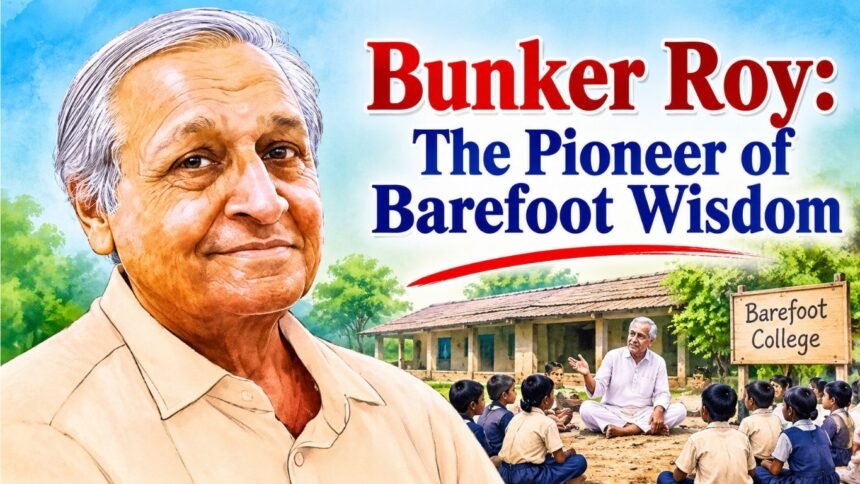
Sanjit “Bunker” Roy (1945–2026) stood as a seminal figure in India’s post-independence social development ecosystem, pioneering a radical critique of elite expertise through the establishment of the Social Work and Research Centre (SWRC)—widely known as Barefoot College—at Tilonia in Rajasthan’s Ajmer district.
Roy’s institutional architecture challenged the conventional monopolies of formal higher education by grounding human agency, pedagogical practice, and technological sovereignty in the experiential wisdom of marginalized rural communities. Long before decentralized innovation and grassroots entrepreneurship became standard vocabulary in development literature, he conceptualized a paradigm where rural women—frequently constrained by deep-seated patriarchal customs like the ghunghat (veil)—were trained as solar engineers, rainwater harvesting technicians, healthcare providers, and community organizers. Upon graduating from this demystified learning environment, these women transformed into self-reliant leaders and pivotal agents of localized governance and ecological sustainability.
During my own field studies—both for my Research Training Programme at CSSSC and later for my doctoral fieldwork—Roy offered far more than intellectual provocation. He extended warm hospitality and an expansive spirit during my stays at Tilonia, instilling invaluable lessons in grounded praxis. He created an environment where researchers were compelled to confront the limitations of urban-centric academic discourse. Unmoved by institutional prestige or the allure of global academia, Roy dedicated his life to surrounding himself with local social engineers, community artisans, and barefoot intellectuals.
Let us avoid saying ‘rest in peace.’ Instead, let us take a bow and strive to draw inspiration from his everyday approach to specific ‘locals’ and the folks whose lives have their own nuances. Such an approach offers a model to any scholar committed to understanding the grassroots—a process that gives us space to develop a vernacularised understanding of rural people and how they engage with the democratic process to find solutions free from imported abstractions, grounded in local specificities. It is an approach that echoes Gandhian ideals or offers a glimpse into the local ideologues and folk icons of the communities we set out to study.
In his passing, India has lost a relentless practitioner of simple living and a visionary pioneer of bottom-up social transformation, whose legacy remains permanently etched into the soil of Tilonia and the lives of the women he empowered.
By Dr. Bijaya Kumar Mohanty
Ramjas College,
Department of Political Science,
University of Delhi
Comments
0 comments