
7 October 2026
Dear serving members of the All India and Central Services,
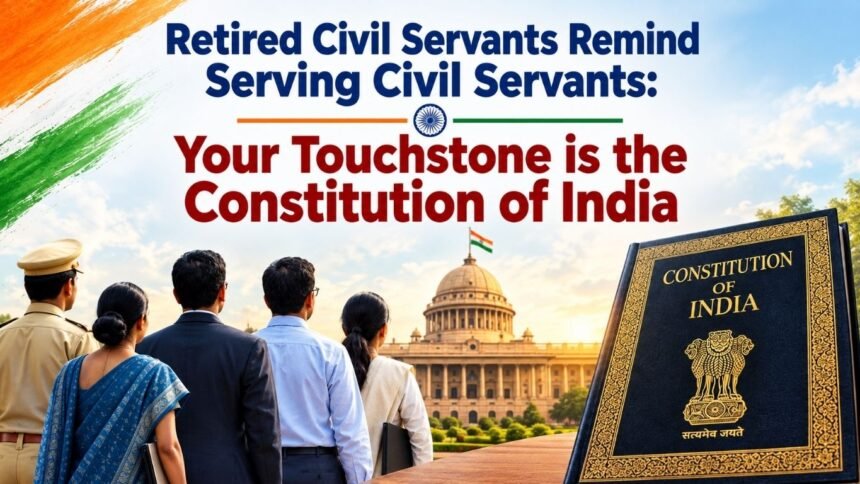
The Constitutional Conduct Group, a collective of former civil servants from the All India and Central Services, came into being nine years ago to uphold the primacy of Constitutional values in India’s polity and society. Through our over hundred letters, a number of conclaves and seminars, we have sought to sensitise the political class, the bureaucracy and the public to the critical need to observe the values enshrined in the Constitution of India in all policies, actions and daily behaviour. We feel compelled to write today at a juncture in our country’s history when Constitutional values are being openly breached and when democratic dialogue and discussion are virtually absent, with any expression of dissent or difference of opinion being termed ‘anti-national’.
- A recent incident, which has reverberated through the country, is the chain of events culminating in the unfortunate events of July 20th the youth protest at Jantar Mantar, the attempted march to Parliament and the police mishandling of events. The Delhi Police, which saw a change in its Commissioner of Police only three days earlier, seemed to have both underestimated and overreacted to the crowd gathered for the march to Parliament. Not only were the crowd control measures employed disproportionate to the situation on the ground, it also appears from visual records that some policemen and officers showed excessive enthusiasm in the use of force, viz. lathi charges, tear gas, pellet gun firing and other brutalities.
- Over the past decade, the union government has rarely adopted a process of dialogue and discussion to frame policies or resolve issues, whether it be the demonetisation debacle, the rush to introduce GST, the abrogation of Article 370, the CAA legislation, the aborted farm laws, the new criminal laws or the delimitation of constituencies. The NEET fiasco and its aftermath is only the latest such aberration. In such an environment, the role of senior civil servants in the bureaucracy and police in upholding the values enshrined in the Constitution of India becomes crucial. The advice given by Sardar Patel to the first recruits to the IAS in 1947 and his speech in the Constituent Assembly in October 1949 are particularly relevant to the present day:
“A civil servant cannot afford to and must not take part in politics, nor must he involve himself in communal wrangles. To depart from the path of rectitude in either of these respects is to debase public services and to lower its dignity.”
“If you do not give your honest opinion for fear that it will displease your minister, please then you had better go. I will bring another secretary. I will never be displeased over a frank expression of opinion.”
- The most glaring example of wilful disregard of constitutional ethics is that of the present Election Commission of India (ECI) (which currently consists entirely of former IAS officers) bringing about inexplicable changes in electoral registration processes. In introducing the arbitrarily designed SIR, they used their constitutional authority to convert what until then was a routine administrative procedure into a measure designed to exclude and disenfranchise millions of genuine voters for brazenly unconstitutional, partisan and political ends. This process had no precedent, no clear basis in law, and no verified necessity. By shifting the onus on the citizens to enlist themselves as voters and show documentary proof of their legitimacy, by overturning the natural presumption of citizenship that existed in their favour and instead requiring them to show documents which few of them had access to (even when they were already registered as voters), by introducing lineage as the basis of voting rights, the ECI ensured that the stated purpose of “purification” of the rolls created panic and fear in large sections of the Indian population.
- The tragedy lies in the fact that the responsibility for converting an institution acclaimed for its independence into an instrument of State power for the pursuit of an objective that creates a class of stateless residents lies with a group of people drawn from the All India Services (AIS). This has been a particularly egregious example of political partisanship perhaps unparalleled in the history of independent India. In one stroke, these officers have not merely irreparably damaged the reputation of an institution built by their predecessors with assiduous care, but have damaged the very foundations of our electoral democracy. The current revelations in the Indian Express of the unilateral manner of functioning of the Chief Election Commissioner (CEC), Gyanesh Kumar, and a group of his lieutenants in the ECI expose the machinations involved in the entire SIR exercise. The two Election Commissioners, too, acquiesced for months in the unilateral decisions of the CEC, despite the law empowering them, as the majority in the ECI, to insist that their opinions must be the final decision. Their participation in and ratification of the decisions taken in the meeting of the three Commissioners on 26 September 2026 not only exposes the flawed, indeed, illegal decisions taken earlier but also renders them liable to the charge of participating in a cover up of these decisions.
- As former colleagues, we find it painful that, apart from the top levels of the ECI, so many civil servants seem to have surrendered their independence of authority and the discretion accorded to them to allow partisan objectives to succeed. We have already touched above on the ham-handed manner in which the Delhi Police handled the situation on 20 July. AIS and Central Services officers working in agencies like the Income Tax department, Enforcement Directorate, CBI and the Narcotics Control Bureau as well as the police force have been complicit in the unnecessary harassment of individuals and institutions deemed to be opposed to the government of the day. Cases are registered under provisions of draconian laws like the UAPA, PMLA and NDPS: investigations are allowed to drag on interminably, with the process of justice itself becoming the punishment, given the ponderous movement of the judicial process and the onerous stipulations for grant of bail.
- In brazen disregard of secular conduct and law, we have the unedifying spectacle of senior police and IAS officers in a state showering flower petals from a helicopter on Kanwar yatris, magistrates clamping down on meat shops and terrorising Muslim shop owners along the Kanwar routes into closing their establishments, at the same time allowing Kanwar yatris to indulge in drunken revelries and attack members of the minority community with complete impunity. In the last twelve years, incidents of communal hate speech and violence have increased exponentially. Offshoots of the Sangh Parivar – the Bajrang Dal, the VHP and hundreds of local outfits which come out of the woodwork every once in a while – instigate and foment unrest in areas where the minority communities are most vulnerable, targeting the Muslim and Christian communities. Perpetrators of hate speech from the majority community are allowed a free run even when they make open calls for genocide. In many states of India, a majoritarian ideology has seeped deep enough into the interstices of the administration such that one can locate its willing advocates and supporters among serving officers of the civil services. Bulldozers continue to be used to demolish selectively the homes and properties (including places of worship) of members of the minority communities as a form of punishment despite Supreme Court orders. The quashing of a number of NSA orders passed in UP in recent months by the Allahabad High Court and the fines imposed by the Supreme Court and the Allahabad High Court on the state government and officers, including the District Magistrate of Gautam Buddha Nagar district, are an indictment of the arbitrary manner in which the right to liberty of citizens is circumscribed. Clearly, the time has come for stronger personal accountability and penalties for administrative and police excesses that violate the fundamental rights of citizens and the core values of the Constitution.
- We also note with mounting concern the manner in which some AIS officers have colluded with the political executive in the destruction of the natural environment over the last twelve years at tremendous cost to forest-dependent communities. The regulatory framework for environmental protection so assiduously constructed by earlier governments has been systematically dismantled by the 2023 amendments to the Forest (Conservation) Act, and by the 2020 changes to the 2006 EIA notification. The Ministry of Environment has forsaken its regulatory role and has become a facilitator for big industry. This is established by the fact that almost 98% of submitted projects receive environmental clearance. Between 2018 and 2022, the number of environmental, forest, wildlife, and coastal zone clearances jumped 20-fold, from 577 to over 12000 in a single year! The farce of EIA approvals to the Great Nicobar project and the failed attempt to throw open the Aravallis for mining and real estate do not bear repetition. The Ministry of Environment at the Centre and in the States are all manned by IAS and IFOS cadre officers, and none of this would have been possible without the active participation of these officers.
- We do not claim a moral high ground or wish to lecture you on the primary allegiance as civil servants that you have to the Constitution of India. We are fully cognisant of the fact that the erosion in strict adherence to Constitutional principles had begun long before the present regime came into power, and then, as now, the spineless outnumbered those who stood up for principles. But there was then a peer culture in the civil services – the ‘esprit de corps’ and a healthy respect for those who took a stand. There were many small acts of resistance which ensured that the legacy of fair and impartial conduct, of maintaining the paramountcy of Constitutional values in one’s conduct, remained intact. We are also aware that you have to work in an environment which is far less accommodative and broadminded than the one we all worked in. The political class then was more tolerant of dissenting views of officers and also did not compel officers to comply with its orders under fear of adverse consequences. It is also a commentary on the present day that other institutions like the judiciary and the media were seen by the civil services of bygone years as their fallback support at times of friction with the political establishment, a situation that cannot be taken for granted today.
- Despite the vastly different environment in which you have to carry out your duties today, we appeal to you to adhere to your primary allegiance to the Constitution and the due process of law. When there is a conflict between the orders given to you and the statutory provisions, your duty is to go strictly by the provisions of law in letter and spirit, even where it causes personal inconvenience. As your seniors in service, we will always support you in these endeavours.
SATYAMEVA JAYATE
Constitutional Conduct Group (98 signatories, as below)
| # | Name | Service | Former Position |
| 1. | Anand Arni | RAS (Retd.) | Former Special Secretary, Cabinet Secretariat, GoI |
| 2. | Aruna Bagchee | IAS (Retd.) | Former Joint Secretary, Ministry of Mines, GoI |
| 3. | Sandeep Bagchee | IAS (Retd.) | Former Principal Secretary, Govt. of Maharashtra |
| 4. | J.L. Bajaj | IAS (Retd.) | Former Chairman, Administrative Reforms and Decentralisation Commission, Govt. of Uttar Pradesh |
| 5. | Vappala Balachandran | IPS (Retd.) | Former Special Secretary, Cabinet Secretariat, GoI |
| 6. | Gopalan Balagopal | IAS (Retd.) | Former Special Secretary, Govt. of West Bengal |
| 7. | Chandrashekar Balakrishnan | IAS (Retd.) | Former Secretary, Coal, GoI |
| 8. | Sushant Baliga | Engineering Services (Retd.) | Former Additional Director General, Central PWD, GoI |
| 9. | Rana Banerji | RAS (Retd.) | Former Special Secretary, Cabinet Secretariat, GoI |
| 10. | Sharad Behar | IAS (Retd.) | Former Chief Secretary, Govt. of Madhya Pradesh |
| 11. | Aurobindo Behera | IAS (Retd.) | Former Member, Board of Revenue, Govt. of Odisha |
| 12. | Madhu Bhaduri | IFS (Retd.) | Former Ambassador to Portugal |
| 13. | K.V. Bhagirath | IFS (Retd.) | Former Secretary General, Indian Ocean Rim Association, Mauritius |
| 14. | Nutan Guha Biswas | IAS (Retd.) | Former Member, Police Complaints Authority, Govt. of NCT of Delhi |
| 15. | Meeran C Borwankar | IPS (Retd.) | Former DGP, Bureau of Police Research and Development, GoI |
| 16. | Ravi Budhiraja | IAS (Retd.) | Former Chairman, Jawaharlal Nehru Port Trust, GoI |
| 17. | Maneshwar Singh Chahal | IAS (Retd.) | Former Principal Secretary, Home, Govt. of Punjab |
| 18. | R. Chandramohan | IAS (Retd.) | Former Principal Secretary, Transport and Urban Development, Govt. of NCT of Delhi |
| 19. | Rachel Chatterjee | IAS (Retd.) | Former Special Chief Secretary, Agriculture, Govt. of Andhra Pradesh |
| 20. | Gurjit Singh Cheema | IAS (Retd.) | Former Financial Commissioner (Revenue), Govt. of Punjab |
| 21. | F.T.R. Colaso | IPS (Retd.) | Former Director General of Police, Govt. of Karnataka & former Director General of Police, Govt. of Jammu & Kashmir |
| 22. | Vibha Puri Das | IAS (Retd.) | Former Secretary, Ministry of Tribal Affairs, GoI |
| 23. | P.R. Dasgupta | IAS (Retd.) | Former Chairman, Food Corporation of India, GoI |
| 24. | Pradeep K. Deb | IAS (Retd.) | Former Secretary, Deptt. Of Sports, GoI |
| 25. | M.G. Devasahayam | IAS (Retd.) | Former Secretary, Govt. of Haryana |
| 26. | Sushil Dubey | IFS (Retd.) | Former Ambassador to Sweden |
| 27. | K.P. Fabian | IFS (Retd.) | Former Ambassador to Italy |
| 28. | Prabhu Ghate | IAS (Retd.) | Former Addl. Director General, Department of Tourism, GoI |
| 29. | Arif Ghauri | IRS (Retd.) | Former Governance Adviser, DFID, Govt. of the United Kingdom (on deputation) |
| 30. | Suresh K. Goel | IFS (Retd.) | Former Director General, Indian Council of Cultural Relations, GoI |
| 31. | H.S. Gujral | IFOS (Retd.) | Former Principal Chief Conservator of Forests, Govt. of Punjab |
| 32. | Meena Gupta | IAS (Retd.) | Former Secretary, Ministry of Environment & Forests, GoI |
| 33. | Ravi Vira Gupta | IAS (Retd.) | Former Deputy Governor, Reserve Bank of India |
| 34. | Wajahat Habibullah | IAS (Retd.) | Former Secretary, GoI and former Chief Information Commissioner |
| 35. | Vivek Harinarain | IAS (Retd.) | Govt. of Tamil Nadu |
| 36. | Syed Masood Husain | IES (Retd.) | Former Chairman, Central Water Commission & ex officio Secretary, Ministry of Jal Shakti, GoI |
| 37. | Rasheda Hussain | IRS (Retd.) | Former Director General, National Academy of Customs, Excise & Narcotics |
| 38. | Siraj Hussain | IAS (Retd.) | Former Secretary, Department of Agriculture, GoI |
| 39. | Kamal Jaswal | IAS (Retd.) | Former Secretary, Department of Information Technology, GoI |
| 40. | Naini Jeyaseelan | IAS (Retd.) | Former Secretary, Inter-State Council, GoI |
| 41. | Ashish Joshi | IP&TAFS (Retd.) | Former Principal Controller, Communications Accounts, North Zone, GoI |
| 42. | Najeeb Jung | IAS (Retd.) | Former Lieutenant Governor, Delhi |
| 43. | Vinod C. Khanna | IFS (Retd.) | Former Additional Secretary, MEA, GoI |
| 44. | Gita Kripalani | IRS (Retd.) | Former Member, Settlement Commission, GoI |
| 45. | Sudhir Kumar | IAS (Retd.) | Former Member, Central Administrative Tribunal |
| 46. | Subodh Lal | IPOS (Resigned) | Former Deputy Director General, Ministry of Communications, GoI |
| 47. | Ashok Lavasa | IAS (Retd.) | Former Election Commissioner |
| 48. | Dinesh Malhotra | IAS (Retd.) | Former Secretary, Govt. of Himachal Pradesh |
| 49. | Harsh Mander | IAS (Retd.) | Govt. of Madhya Pradesh |
| 50. | Amitabh Mathur | IPS (Retd.) | Former Special Secretary, Cabinet Secretariat, GoI |
| 51. | Aditi Mehta | IAS (Retd.) | Former Additional Chief Secretary, Govt. of Rajasthan |
| 52. | Malay Mishra | IFS (Retd.) | Former Ambassador to Hungary |
| 53. | Satya Narayan Mohanty | IAS (Retd.) | Former Secretary General, National Human Rights Commission |
| 54. | Sudhansu Mohanty | IDAS (Retd.) | Former Financial Adviser (Defence Services), Ministry of Defence, GoI |
| 55. | Jugal Mohapatra | IAS (Retd.) | Former Secretary, Department of Rural Development, GoI |
| 56. | Ruchira Mukerjee | IP&TAFS (Retd.) | Former Advisor (Finance), Telecom Commission, GoI |
| 57. | Anup Mukerji | IAS (Retd.) | Former Chief Secretary, Govt. of Bihar |
| 58. | Deb Mukharji | IFS (Retd.) | Former High Commissioner to Bangladesh and former Ambassador to Nepal |
| 59. | Jayashree Mukherjee | IAS (Retd.) | Former Additional Chief Secretary, Govt. of Maharashtra |
| 60. | Shiv Shankar Mukherjee | IFS (Retd.) | Former High Commissioner to the United Kingdom |
| 61. | Gautam Mukhopadhaya | IFS (Retd.) | Former Ambassador to Myanmar |
| 62. | Surendra Nath | IAS (Retd.) | Former Member, Finance Commission, Govt. of Madhya Pradesh |
| 63. | P. Joy Oommen | IAS (Retd.) | Former Chief Secretary, Govt. of Chhattisgarh |
| 64. | S.K. Pachauri | IAS (Retd.) | Former Director General, National Productivity Council, GoI |
| 65. | Amitabha Pande | IAS (Retd.) | Former Secretary, Inter-State Council, GoI |
| 66. | Alok Perti | IAS (Retd.) | Former Secretary, Ministry of Coal, GoI |
| 67. | G.K. Pillai | IAS (Retd.) | Former Home Secretary, GoI |
| 68. | Gurnihal Singh Pirzada | IAS (Resigned) | Former MD, Punjab State Electronic Development & Production Corporation, Govt. of Punjab |
| 69. | R. Poornalingam | IAS (Retd.) | Former Secretary, Ministry of Textiles, GoI |
| 70. | Smita Purushottam | IFS (Retd.) | Former Ambassador to Switzerland |
| 71. | T.R. Raghunandan | IAS (Retd.) | Former Joint Secretary, Ministry of Panchayati Raj, GoI |
| 72. | V.P. Raja | IAS (Retd.) | Former Chairman, Maharashtra Electricity Regulatory Commission |
| 73. | V. Ramani | IAS (Retd.) | Former Director General, YASHADA, Govt. of Maharashtra |
| 74. | P.V. Ramesh | IAS (Retd.) | Former Addl. Chief Secretary to the Chief Minister of Andhra Pradesh |
| 75. | K. Sujatha Rao | IAS (Retd.) | Former Health Secretary, GoI |
| 76. | Madhukumar Reddy A. | IRTS (Retd.) | Former Principal Executive Director, Railway Board, GoI |
| 77. | Satwant Reddy | IAS (Retd.) | Former Secretary, Chemicals and Petrochemicals, GoI |
| 78. | Julio Ribeiro | IPS (Retd.) | Former Director General of Police, Govt. of Punjab |
| 79. | Manabendra N. Roy | IAS (Retd.) | Former Additional Chief Secretary, Govt. of West Bengal |
| 80. | Deepak Sanan | IAS (Retd.) | Former Principal Adviser (AR) to Chief Minister, Govt. of Himachal Pradesh |
| 81. | Biswaranjan Sasmal | IRS (Retd.) | Former Additional Secretary, Department of Social Justice Empowerment, GoI |
| 82. | N.C. Saxena | IAS (Retd.) | Former Secretary, Planning Commission, GoI |
| 83. | A. Selvaraj | IRS (Retd.) | Former Chief Commissioner, Income Tax, Chennai, GoI |
| 84. | Ardhendu Sen | IAS (Retd.) | Former Chief Secretary, Govt. of West Bengal |
| 85. | Aftab Seth | IFS (Retd.) | Former Ambassador to Japan |
| 86. | Ashok Kumar Sharma | IFOS (Retd.) | Former MD, State Forest Development Corporation, Govt. of Gujarat |
| 87. | Ashok Kumar Sharma | IFS (Retd.) | Former Ambassador to Finland and Estonia |
| 88. | Raju Sharma | IAS (Retd.) | Former Member, Board of Revenue, Govt. of Uttar Pradesh |
| 89. | Shivendu | IAS (Retd.) | Former Secretary, Health & Member (Finance), Jharkhand State Electricity Board, Govt. of Jharkhand |
| 90. | Avay Shukla | IAS (Retd.) | Former Additional Chief Secretary (Forests & Technical Education), Govt. of Himachal Pradesh |
| 91. | K.S. Sidhu | IAS (Retd.) | Former Principal Secretary, Govt. of Maharashtra |
| 92. | Mukteshwar Singh | IAS (Retd.) | Former Member, Madhya Pradesh Public Service Commission |
| 93. | Swaraj Bir Singh | IPS (Retd.) | Former Director General of Police, Govt. of Meghalaya |
| 94. | Tara Ajai Singh | IAS (Retd.) | Former Additional Chief Secretary, Govt. of Karnataka |
| 95. | Mridula Sinha | IAS (Retd.) | Former Director General, Administrative Training Institute, Govt. of Jharkhand |
| 96. | Prakriti Srivastava | IFOS (Retd.) | Former Principal Chief Conservator of Forests & Special Officer, Rebuild Kerala Development Programme, Govt. of Kerala |
| 97. | Anup Thakur | IAS (Retd.) | Former Member, National Consumer Disputes Redressal Commission |
| 98. | P.S.S. Thomas | IAS (Retd.) | Former Secretary General, National Human Rights Commission |
Comments
0 comments