
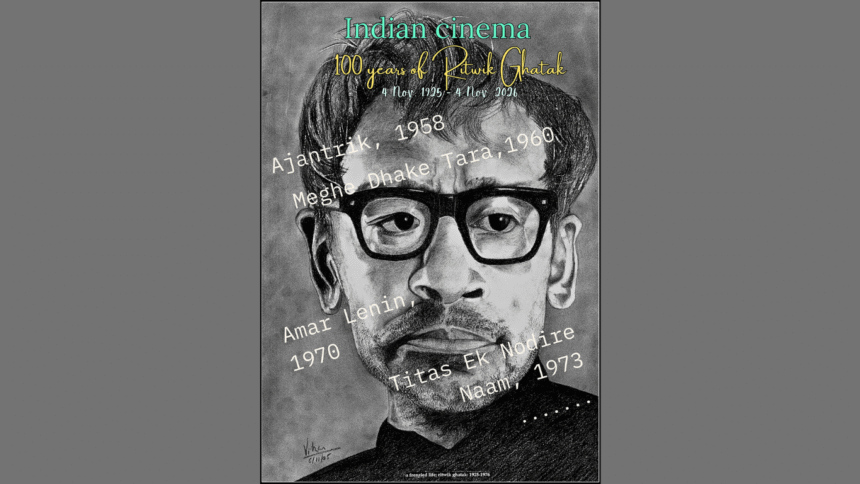
Just a few days back I saw a proclaiming a celebration of 100 years of the legendary Bengali cinema director Ritwik Ghatak on the entrance gate of School of Social Sciences II building where my Centre is located. The poster immediately reminded me of this sketch which I had made twenty-one years back. The sketch however has a history of at least twenty three to twenty four years.
There is a very dear friend of mine, Parvez Imam. I may tenuously add the prefix Dr to his name and you shall soon understand why. Parvez left a MD degree in radio-diagnosis at the Jawaharlal Nehru Medical College, Aligarh Muslim University to pursue his desire to work in psychiatry. His motivation to do so was very different from what many clinical psychiatrists would find theirs to be. Parvez, I believe, was more interested in exploring the cosmology of the inner caverns of the human mind than just working out the ‘chemical locha’ in peoples’ brains. I do not know what finally marked his parting of ways with psychiatry, but then he gave up medicine to become a musician, a film maker with his own production company, professionally organising treks into Himalayas, and for quite some time even became a homemaker with his family in Switzerland. I am too far now to follow him closely. But, I hope that explains the tenuous nature of his prefix ‘Dr.’ Had I not done a PhD, I would have equally earned this predilection even though the path I took away from clinical medicine was way too different.
Around 2001-02, I had been passing through a serious crisis in life which was traumatising my physical and mental being. I would often lend the caverns of my mind to Parvez in a hope he would pull out something to provide succour to me so desperately sought.
One evening after a session of counselling with him in his office in Lajpat Nagar as I turned to the door of the office to make my way out, my attention was caught by this tiny photograph, at the max 4 x 3 inches in size, which was kept on the side of a rack in a large steel book frame. The photograph was a newspaper cutting of some gentleman whom I did not know till then and had been put in a small decorative photo frame. The steel frame was full of things, decorative and mundane, and so was the room in general, but my eyes were frozen on this face that seemed to exercise strange control on me; it wouldn’t let go of my sight.
I inquired from Parvez about the person and thus was introduced to one of the classic masters of Indian cinema. He was Ritwik Ghatak. The intensity of the look on his face signals the storm brewing within. The many storms that seemed to torment his mind were not borne out of anxiety for an imagined future, but rather were a product of his efforts to comprehend life as it presented itself; to understand it from the perspective of the commonest of the common humans which finally found expression in the cinematic form. A Marxist and a political activist as he was, Ghatak’s cinematic exertions could not be bereft of a vision and hope for the future. As Drishya writes in the ‘New RIOT’ magazine:
Above all, the protagonists of Ghatak’s films were survivors: they were individuals sapped by a divided society that could only take, take, take from them with little to offer in return, and yet they were driven by the indomitable human instinct for survival.
It is unfortunate that Ghatak was hardly acknowledged in his lifetime. As Parvez told me, it took Ghatak to be discovered by the French Cinema and perhaps the Americans, before we rediscovered him as our own. What is more dangerous is that Ghatak has not been rediscovered as an icon of the wretched of the Indian earth, but as a new cultural icon of the glitterati, who might ultimately succeed in turning his gaunt appearance into another portrait a la ‘Che’of the t – shirts of the new age film enthusiasts.
But none of this takes away from the binary that now seems forever entrenched: “Ray or Ghatak?” Satyajit Ray himself spoke of Ghatak, though much later in life:
One of the few truly original talents in the cinema this country has produced… As a creator of powerful images in an epic style he was virtually unsurpassed in Indian cinema.
While in school, Doordarshan had introduced me to the works of Ray; while in medical college I was introduced to some of the finest Soviet cinema by a professor of mine, and now Parvez introduced me to Ghatak. The first film he gave me to watch was ‘Titash ek nodire naam.’ This was followed by ‘Meghe dhake tara’ and then another comrade from the Indian Federation of Trade Unions asked me to watch ‘Ajaantrik.’ I discovered ‘Amar Lenin’ on the U tube myself. This leaves a lot more to watch still even as the imprint of the initial viewing of these few has gone blur in my mind. I hope to exchange notes after we have watched these again for ourselves and for the pursuit in life we have made common among ourselves.
In those days smart phones were probably not there or were still a rarity, so I borrowed the photo from Parvez until I exorcised myself of Ghatak’s intense gaze by making a sketch of him another two to three years down the line. As to the sketch, it is a plain and simple copy of one of the most commonly available photos of Ritwik Ghatak. My concern is lest I have contributed to rendering Ghatak as another elite cultural icon. Times when the working classes of India could savour the most refined works of art inspired by their trials and travails still seem too far in future. Till then these works shall continue to be appropriated by the suave to keep their souls at peace, except of course some loose cannons who might get ignited by these ethereal expressions to serve the larger public good – that of transforming the society.
(Dr. Vikas Bajpai teaches at the Centre of Social Medicine and Community Health, School of Social Sciences, Jawaharlal Nehru University, New Delhi. He has co-authored with Prof. Anoop Saraya of AIIMS, Delhi two important books broadly in the area of political economy of health. – Samadrusti )

Comments
0 comments