
A Review of Aurobindo Rout’s Book on the Forest Rights Act
What is a forest? Is it merely a geographical expanse of trees, wildlife and natural resources, or is it also an inseparable world of people, livelihoods, cultures, memories and collective life shaped over generations? Aurobindo Rout’s book, Forests, Communities, and Forest Rights: Experiences, Challenges, and Possibilities in the Implementation of the Forest Rights Act, begins with this fundamental question and invites the reader to see forests from a different perspective.
This volume is the English translation of the author’s original Odia book, Jangal, Samuha O Adhikar. It makes reflections rooted in Odisha’s field realities accessible to a wider readership of community leaders, researchers, administrators, activists and students, while opening its arguments to the national conversation on forest tenure, conservation and democratic governance.
The book is not a clause-by-clause explanation of the Scheduled Tribes and Other Traditional Forest Dwellers Recognition of Forest Rights Act, 2006. It explores the law’s historical background, moral foundations and everyday implementation. Colonial forest administration treated forests largely as reserves of timber and revenue. Communities that had lived with, used and protected these forests for generations were gradually rendered encroachers on their own customary lands. The author rightly emphasises that the Forest Rights Act does not bestow a new benefit through administrative generosity; it recognises pre-existing rights that were historically denied. This distinction between granting rights and recognising rights runs through the book.
One of its strongest contributions is its importance of the Gram Sabha. Rout presents it not as a ceremonial body convened merely to approve claims, but as a legally empowered institution of local self-governance. Drawing connections among the Constitution, the Panchayati Raj framework, the Panchayats Extension to Scheduled Areas Act and the Forest Rights Act, he explains the Gram Sabha’s authority in determining rights and conserving, governing and managing Community Forest Resources.
The essays address difficult but essential issues: the distinction between community rights and Community Forest Resource rights; conversion of forest villages into revenue villages; habitat rights of Particularly Vulnerable Tribal Groups; claims of Other Traditional Forest Dwellers; women’s land and forest rights; livelihood security; protected areas; and community-led conservation. These questions are explained accessibly without losing their legal and political complexity.
Rout writes not as a distant observer but as a practitioner shaped by nearly two decades of engagement with forest-dependent communities, Gram Sabhas, field workers and government institutions. Consequently, the book carries the texture of lived experience: claims pending for years, applications rejected on procedural grounds, official reluctance to respect Gram Sabha decisions, and communities receiving titles without gaining meaningful control over their resources. The relationship between secure tenure, food security, dignified livelihoods, migration and poverty is especially well brought out.
The book also challenges the familiar assumption that conservation and community rights are inherently opposed. Its discussions of customary stewardship, women’s participation, collective rules and biodiversity governance demonstrate that forest communities can be among the most dependable custodians of forests. Equally significant are the warnings about changing forest and environmental laws, compensatory afforestation, expansion of protected areas and the uncritical use of technology. Digital maps and technical systems can support implementation, the author argues, but they cannot replace community knowledge, customary boundaries or the informed decisions of the Gram Sabha.
As a collection of essays written at different moments, the book occasionally revisits the background of the Act and the role of the Gram Sabha. More consolidated data, district-level comparisons and chapter references might have strengthened its value for researchers. Yet the repetition also reveals unresolved questions and the continuing distance between the promise of the law and its performance on the ground.
The book’s greatest achievement lies in taking the Forest Rights Act out of files and official language and locating it within the lives of villages and forest-dependent communities. It adopts a clear ethical position in favour of those who have endured historical injustice, while grounding that position in law, constitutional values, policy analysis and field experience. Ultimately, the book leaves the reader with a compelling understanding: the future of forests cannot be separated from the rights and future of the people who have lived with and cared for them. This is a thoughtful and valuable contribution to the literature on forest rights and democratic forest governance in India.
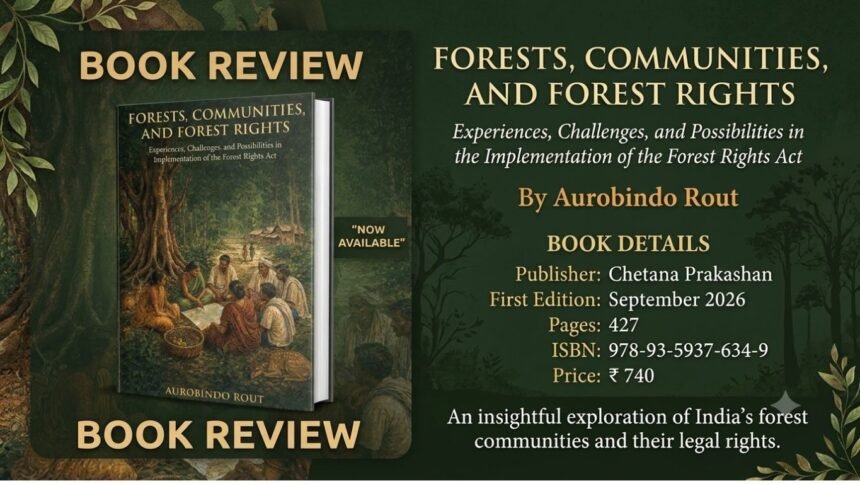
Book Details
Title: Forests, Communities, and Forest Rights
Subtitle: Experiences, Challenges, and Possibilities in the Implementation of the Forest Rights Act
Author: Aurobindo Rout
Publisher: Chetana Prakashan
First Edition: September 2026
Pages: 427
ISBN: 978-93-5937-634-9
Price: Rs. 740
Comments
0 comments